This is the first in a series of public information explaining the 2026-27 budget.
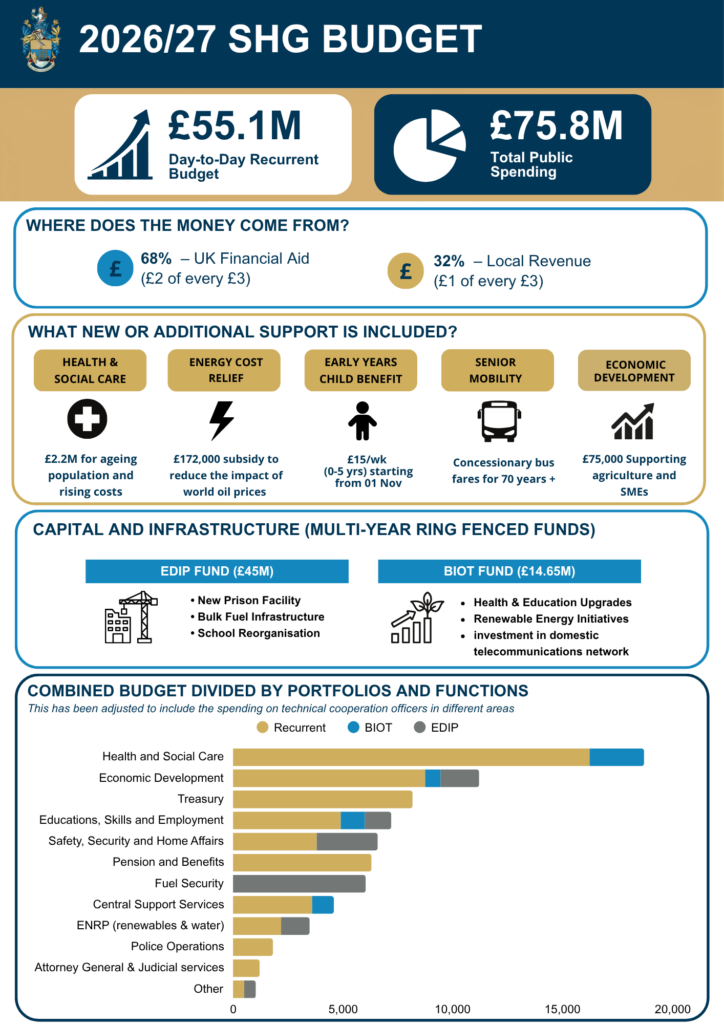
The St Helena Government (SHG) has published its 2026/27 Budget Book, setting out a main budget of just over £55 million. This is the recurrent budget which provides for the public services people rely on day to day, as well as introducing new support, and investment to make services and the economy more sustainable over time.
Underpinned by a newly agreed three-year aid settlement with the UK Government, the budget provides long-term financial stability, strengthens economic resilience, and introduces targeted support to help lower everyday living costs for residents.
How much is in the day-to-day budget?
Government expects £55.058 million (55.1 when rounded up) in recurrent revenue in 2026/27. This is the money available mainly to fund day-to-day services and operations.
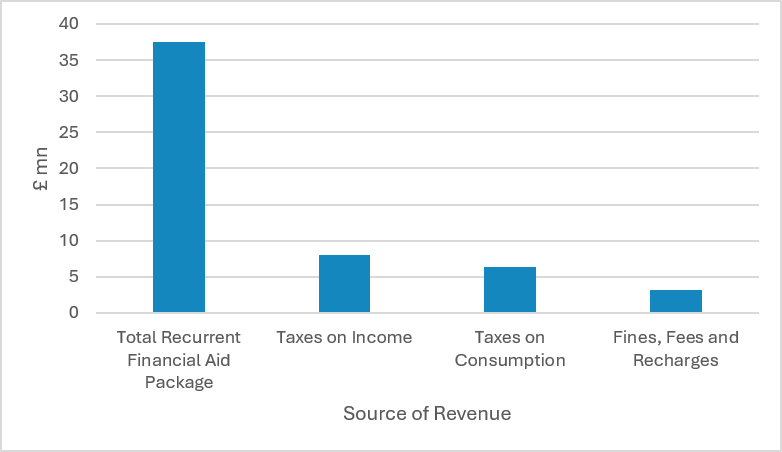
Approximately 68% of the recurrent budget is supported by UK financial aid, with 32% generated locally through income tax, customs duty, fees and charges. Put simply, for every £3 spent, approximately £2 comes from UK aid and £1 from local revenue.
Source of Government Revenue for Recurrent Budget 2026/27.
Recurrent expenditure is forecast to be £55.277 million. The small difference between revenue and expenditure, together with other movements, means £414,000 is expected to be drawn from the General Reserve during the year.
The three-year UK agreement gives St Helena the stability needed to plan ahead. It also offers an additional £1 million in funding for Years Two and Three if key conditions are met, starting with balancing the budget outturn each year.
What new or additional support is included?
The majority of the £55.1 million recurrent budget sustains vital day-to-day public services, with health and social care accounting for nearly one-third of overall spending due to an ageing demographic and rising medical costs. Examples of these services include helping with overseas medical referrals, air access, the Connect utility subsidy, public transport, the ferry service, fishing and farming support, the Basic Island Pension, Income Related Benefit and home care support, and substantially subsidised fees and charges across many other services.
While most of the money is spent on supporting key services that help everyone every day, there are several new policies in this budget:
• Health and Social Care Support: An additional £2.2 million allocated to support the ageing population and manage the rising medical costs.
• Energy Cost Relief: A £172,000 subsidy to reduce the impact of higher world oil prices on energy bills, capping the expected increase at 1p per kWh rather than 3p.
• Early Years Child Benefit: Introduction of a new benefit for children aged 0 to 5, starting at £15 per week and rising to £20 per week in Year Two, Implementation will start from 1 November. Further information on access to child benefit will be published shortly.
• Senior Mobility: Introduction of concessionary public transport fares for residents over 70.
• Pension and Economic Development: Working towards a sustainable increase in the Basic Island Pension and strengthening economic growth and employment with measures to help agriculture and and small to medium enterprises.
Spending in 2026/27 from the Recurrent Budget
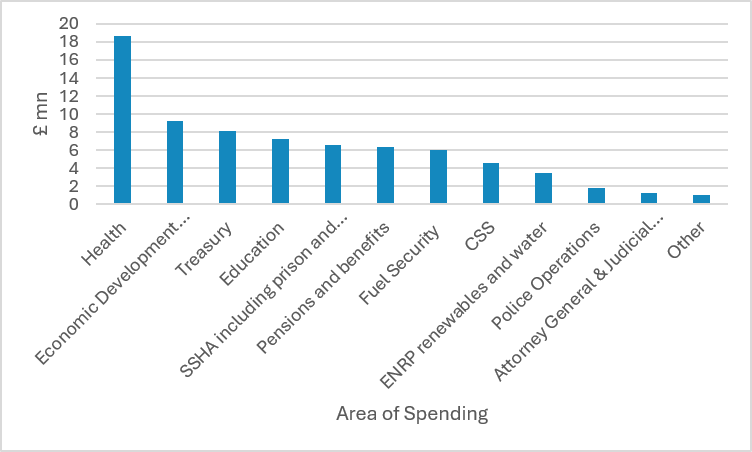
The chart below shows how the government budget is divided across key service areas. Health and Social Care accounts for the greatest share of spending. Treasury spending includes payments made on behalf of the crown such as the subsidy to Connect Saint Helena and the contingency budget used mainly to fund the losses on the Air Service.
Public Expenditure from the Recurrent Budget by Different Portfolios and Functions
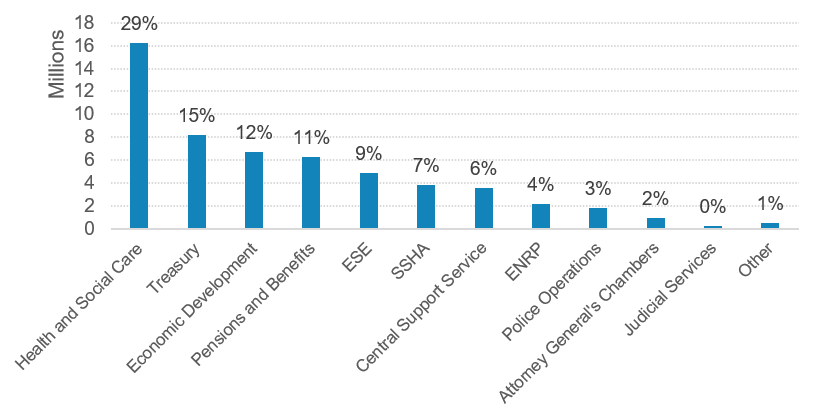
This has been adjusted to take account of the spending on technical cooperation officers in different areas.
Beyond the Recurrent Budget: Capital and Development Funding
On top of the recurrent budget, St Helena receives separate funding from two additional sources specifically for investment supporting society and the economy.
- Economic Development Investment Programme (EDIP): Provides £45 million (including £5 million carryover) through to 2028/29 for key infrastructure projects, including the new prison facility, the Bulk Fuel Infrastructure, school reorganisation. These take up the bulk of the funding. Other smaller projects include improving water treatment in Half Tree Hollow and Jamestown.
- British Indian Ocean Territory (BIOT) Funding: Delivers £14.65 million across two tranches through to 2030/31 and is allocated or indicatively planned for health, education, digital systems, telecommunications and renewable energy.
These two sources of funding are linked to specific objectives so business cases and approvals will be needed. The government plans to bring forward other projects into the pipeline, including energy renewables to make sure the government is able to use these funds effectively.
Some of these funds are temporary, so the government needs to be careful about how it is invested. If these funds were used for day-to-day running costs, the government would need to find alternative funding when the temporary funding ends, creating financial pressures or cuts to services in the long run.
All Public Spending Combined (2026/27)
| 2026/27 | |
| Total Revenue in recurrent budget including local revenue | 55.1 |
| EDIP | 15.0 |
| BIOT | 5.3 |
| Change in reserves | 0.4 |
| Combined Total | 75.8 |
When combined with the ring-fenced infrastructure and development funding, total public spending capability reaches £75.8 million in 2026/27, further boosting health, education and infrastructure development. If the EDIP and BIOT funding is taken forward as set out in the indicative projections the budget, spending on different portfolios and their linked infrastructure projects will be as set out below.
Indicative Public Expenditure by Different Portfolios and Functions 2026/27
SHG Budget infographic