
Government Structure
This webpage seeks to provide an overview of the Government with reference to the Constitutional authority, the various roles and responsibilities and what happens in practice.
St Helena is a British Overseas Territory and is in receipt of UK Government (UKG) financial assistance to support recurrent and capital expenditure as part of the UKG’s obligation to ensure that the reasonable needs of the population are met. The Governor is appointed by His Majesty the King on the advice of the British Government and acts as the Constitutional Head of Government and Commander-in-Chief of the Territory (St Helena, Ascension and Tristan da Cunha). The Chief Minister is the Elected Head of the Government. The St Helena Government Structure has three branches, the Executive, the Legislature, and the Judiciary, with the Judiciary being independent of the Executive and the Legislature. As shown in the figure below, these branches are supported by the Public Service.
The Ministerial form of Government was introduced in 2021 following consultation and majority vote. Unlike the UK and various other jurisdictions, St Helena does not have political parties. For St Helena, this is a form of government where executive power is exercised by a Chief Ministers and their Ministerial team, who are collectively responsible to the legislature and individually responsible for their respective government portfolios. This means that Ministers are individually accountable to Legislative Council for their own actions and the actions of their portfolios, and collectively responsible for the overall performance of the government.
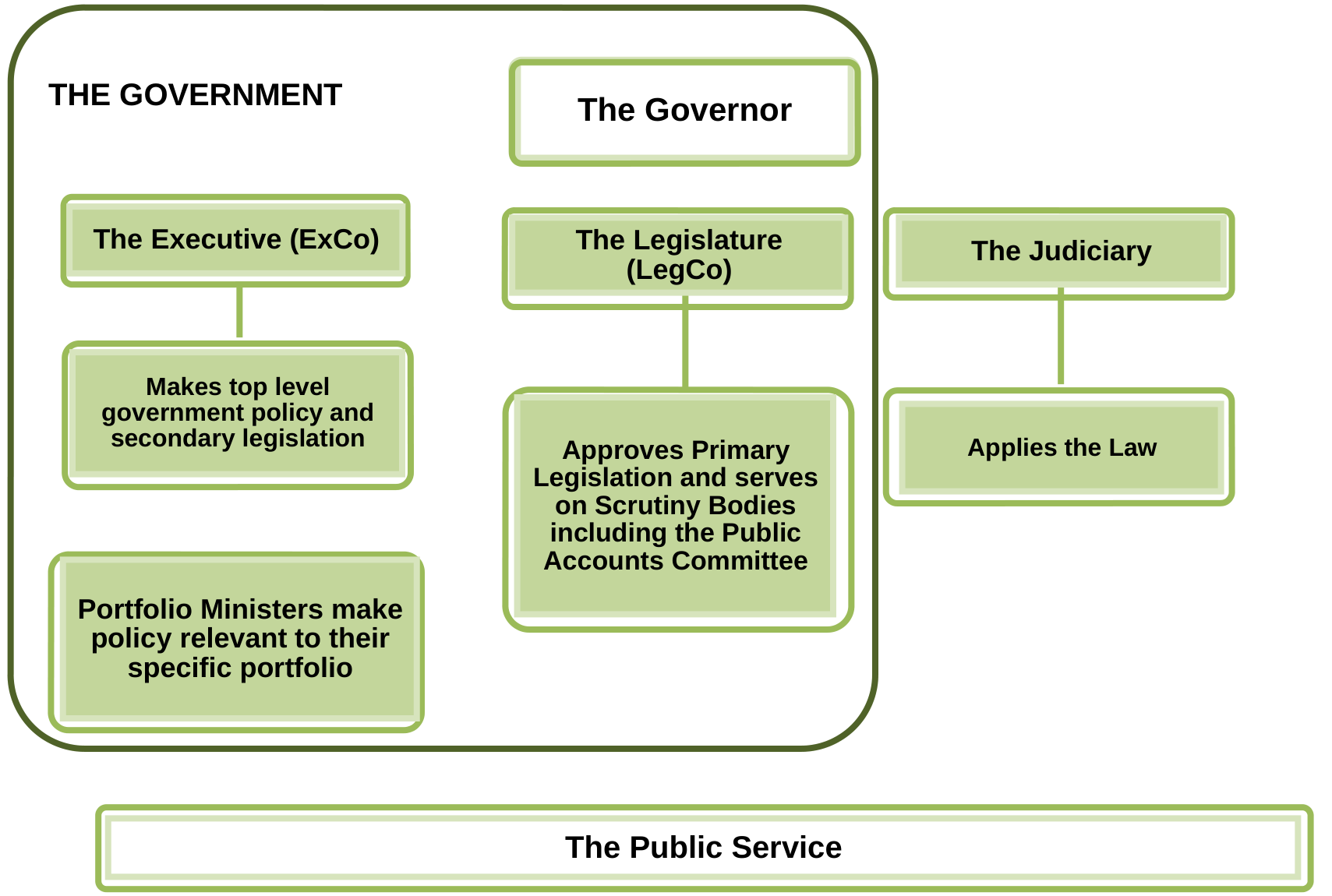
Diagram text
- THE GOVERNMENT
- The Governor
- The Executive (ExCo)
- Makes top level government policy and secondary legislation
- The Legislature (LegCo)
- Approves Primary Legislation and serves on Scrutiny Bodies including the Public Accounts Committee
- Portfolio Ministers make policy relevant to their specific portfolio
- The Judiciary
- Applies the Law
- The Public Service
Extracts from the Constitution of St Helena, Ascension and Tristan da Cunha
CONSTITUTIONAL AUTHORITY
The Governor
26. (1) There shall be a Governor of St Helena.
(2) Appointments to the office of Governor shall be made by His Majesty by Commission under His Sign Manual and Signet and a person appointed to the office shall hold office during His Majesty’s pleasure.
(3) A person appointed to the office of Governor shall, before entering upon the functions of that office, make before the Sheriff of St Helena oaths or affirmations of allegiance and for the due execution of that office in the forms set out in the Schedule.
(4) The Governor shall have such functions as are conferred or imposed on him or her by this Constitution or any other law and such other functions as His Majesty may from time to time be pleased to assign to him or her through a Secretary of State, and, subject to the provisions of this Constitution and of any other law by which any such functions are conferred or imposed, shall do and execute all things that belong to his or her office according to such instructions, if any, as His Majesty may from time to time see fit to give him or her through a Secretary of State; but no court shall enquire whether or not he or she has complied with any such instructions.
Governor’s special responsibilities
44.21 (1) The Governor shall be responsible for the conduct (subject to this Constitution and any other law) of any business of the Government of St Helena, including the general direction and policy control of any department of government, with respect to the following matters—
(a) defence;
(b) external affairs;
(c) internal security, including the Police;
(d) the appointment of any person to any office in the St Helena Public Service, the suspension, termination of employment, dismissal, or retirement of any officer of the St Helena Public Service or the taking of disciplinary action in respect of such an officer, and the application to any such officer of the terms or conditions of employment of the Public Service (including salary scales, allowances, leave, passages or pensions) for which financial provision has been made;
(e) the administration of justice; and
(f) finance.
(g) …
(1A) The Governor, acting in his or her discretion, may by directions in writing delegate, with the prior approval of a Secretary of State, to the Chief Minister or any other Minister recommended by the Chief Minister such responsibility for any of the matters specified in subsection (1) (c), (e) and (f) as the Governor may think fit upon such conditions as he or she may impose. A Minister to whom such a responsibility has been delegated shall exercise that responsibility in accordance with section 36.
What happens in practice – Roles and responsibilities
The Governor is appointed by the HM the King and is normally in office for a period of up to 4 years.
The Governor is supported by staff appointed by the FCDO who are a part of the Governor’s Office and by the PA to the Governor who is an SHG employee.
The Governor presides over Executive Council and also have regular and separate meetings with the Chief Minister and with his direct reports ie the Chief Secretary, the Attorney General, the Chief Auditor and the Chief of Police
The Governor has wide ranging constitutional responsibilities, including:
- The powers of pardon relevant to convictions and imprisonment of offenders. In this regard the Governor chairs the Advisory Committee on the Prerogative of Mercy. See sections 29 and 30 of the Constitution
- Responsibility for the appointment of the Chief Minister who is elected by Elected Members and appointment of Ministers after they have been selected by the Chief Minister
- Responsibility for the appointment of other persons to serve on statutory boards and committees
Special Responsibilities
Section 44.21 (1) of the Constitution assigns special responsibilities to the Governor.
The Governor may however delegate some of these special responsibilities ie internal security, including the Police; the administration of justice; and, finance, to the Chief Minister or any other Minister as may be recommended by the Chief Minister. Such delegation would need to consider what constraints and safeguards would need to be put in place.
Section 95 of the Constitution makes provision for the Governor to delegate responsibility for the management and operation of the Public Service to an officer or officers within that Service. This responsibility has been delegated to the Chief Secretary who is also the Head of Public Service.
See role of the Chief Secretary
Emergency Powers
The Emergency Powers Ordinance, 1978 and the Emergency Powers (Overseas Territories) Order 2017, provides for the Governor in Council to make Regulations if the Governor is of the view that a situation is likely to interfere with public safety or disrupt the supply or distribution of essential commodities to the people of St Helena. Where practicable, the Governor will consult with the Executive Council before making a Proclamation of Emergency.
It is difficult to relate how emergency powers might be used until the emergency is known.
The Steering Committee
The Governor also chairs the Steering Committee which has been established to support the delivery of Saint Helena Government’s (SHG) Vison and Strategy. Where development programmes are funded by the UK Government, the SC will ensure they are aligned with SHG’s strategic objectives, meet donor compliance requirements monitor progress and provide direction when required.
Steering Committee membership comprises Chief Minister, SHG Ministers, Chief Secretary, Financial Secretary, UKG/FCDO Deputy Director for Overseas Territories, UKG/FCDO St Helena Team Leader, Head of SHG Programme Management Office and the Development Attaché from the Governor’s Office
The Committee’s responsibilities and objectives include:
- Approve strategic programmes and projects for St Helena.
- Provide high level oversight to delivery of development funded programmes.
- Monitor SHG’s strategic risks to ensure residual risks rated high or above are factored into Steering Committee decision making.
- Approve proposals for capital programmes against priorities for St Helena, relevant Business Case objectives, affordability, and value for money considerations.
- Provide strategic direction about the priorities for capital programmes and projects
CONSTITUTIONAL AUTHORITY
Executive Council
35.3 (1) There shall be an Executive Council for St Helena, which shall consist of—
(a) the Chief Minister appointed by the Governor in accordance with section 37C(1)(a);
(b) four other Ministers appointed by the Governor in accordance with section 37C(1)(b); and
(c) the Attorney General, as ex officio member, without the right to vote.
What happens in practice – Roles and responsibilities
Executive Council is chaired by the Governor and is the highest level decision making body on the Island . Meetings are currently held on a monthly basis and are held in private. See role of Executive Council.
The Chief Minister is elected by secret ballot by the 12 elected members at the inaugural meeting of the Legislative Council following which the Chief Minister is formally appointed by the Governor. See role of Chief Minister
The four Ministers are selected by the Chief Minister for appointment by the Governor. They are allocated responsibility for a portfolio/function. The Chief Minister also assumes responsibility for a Portfolio/ function. See role of Ministers
The Attorney General, who is the principal legal adviser to the Government of St Helena is an officer of the St Helena Public Service appointed by the Governor, acting in his or her discretion and with the approval of a Secretary of State. (Section 46 of the Constitution refers)
The Chief Secretary, Financial Secretary, Head of Governor’s Officer and the Head of Communications Hub also attend Executive Council meetings in an advisory/supporting capacity. They do not have a vote.
Executive Council is supported by a Secretary appointed by the Governor. (Section 42 of the Constitution refers).
CONSTITUTIONAL AUTHORITY
36.4 The members of the Executive Council shall be collectively responsible to the Legislative Council for any advice given to the Governor by or under the general authority of the Executive Council and for all things done by or under the authority of any Minister in the execution of his or her office.
Ministers may meet together to consider advice to be tendered to the Governor
36A.5 (1) If the Chief Minister so requests, generally or in a particular case, the Ministers shall meet together in order to consider what advice on any matter they wish to tender to the Governor at a meeting of the Executive Council or otherwise.
(2) The Chief Minister may, consistently with the Code of Conduct made under section 71 and after consulting the Director responsible for administering the department to which those officers belong, call upon officers of the St Helena Public Service to provide the meeting with information, advice and administrative support.
(3) The meeting shall be free to regulate its own procedure.
What happens in practice – Roles and responsibilities
The Chief Minister and their four Ministers meet on a regular basis. These meetings are currently referred to as Cabinet meetings. Portfolio directors and senior officers are asked to attend these meetings to provide information and advice as may be required by the Chief Minister/Ministers. No formal decisions are made at these meetings.
Administrative support for Cabinet meetings is provided by the Portfolio Assistant to Central Support Service.
CONSTITUTIONAL AUTHORITY
A Minister’s responsibility for a department
45A.23 (1) Subject to this Constitution and any other law, a Minister who has the responsibility for a department of Government shall exercise general direction and policy control over that department, in accordance with the policies of the Government as determined by the Executive Council.
(2) Subject to the general direction and policy control provided for in subsection (1) and to any law, the department shall be administered by a Director.
(3) The Director shall act as chief policy adviser to the Minister on matters within the department’s responsibility
What happens in practice – Roles and responsibilities
Ministerial Advisory Boards
Ministerial Advisory Boards (the Board) have been established to provide a structure to support Ministerial decision making at the Portfolio level. The Board is chaired by the Portfolio Minister supported by the Portfolio Director (Chief Policy Adviser to the Minister) or his/her designated deputy, and Senior Officials. Other people may be asked to attend at the discretion of the Chair in discussion with the Portfolio Director.
The Board provides a structured forum for the Portfolio to receive strategic direction from the Minister and for the Minister to receive effective and comprehensive policy advice to aid Ministerial decision making, including regular updates on Portfolio risk management, performance and delivery. Boards meet on a monthly basis or more frequently as business may require.
The Boards are advisory in the sense that they provide advice to the Minister on issues within their remit, such as strategy and the deliverability of policies. They are supervisory in the sense that they scrutinise Portfolio performance, and challenge the Portfolio on how well it is achieving its objectives.
However, policy is decided by ministers alone, with advice from officials.
CONSTITUTIONAL AUTHORITY
Standing Orders and Ministers’ Question Time
Standing Orders
68. The Legislative Council may make, amend and revoke Standing Orders consistent with this Constitution for the regulation and orderly conduct of its proceedings and the despatch of business and for the passing of Bills and for their presentation to the Governor for assent
What happens in practice – Roles and responsibilities
Standing Orders Approved by Resolution of the Legislative Council
on the 16th day of December 2022 and Amended by Resolution of the Legislative Council on the 30th day of November 2023, provides Council to convene in order for questions to be put to a Minister – this is referred to as Ministers’ Question Time.
These meetings are currently held once a month on a Tuesday and runs for one hour
CONSTITUTIONAL AUTHORITY
The Attorney General
46. (1) There shall be an Attorney General of St Helena who shall be the principal legal adviser to the Government of St Helena.
(2) The Attorney General shall be an officer of the St Helena Public Service appointed by the Governor, acting in his or her discretion and with the approval of a Secretary of State.
What happens in practice – Roles and responsibilities
The Attorney General is the principal legal adviser to the Governments of St Helena, Ascension and Tristan da Cunha. They carry out functions required of the Attorney General under the Constitution and other laws and policy, either in person or through those to whom authority has been delegated.
The Attorney General serves as an ex-officio member of the Executive and Legislative Councils. Other duties include:
- Management of the legislative programme to ensure that draft legislation is delivered in a realistic timely manner, in line with political priorities subject to instructions, policy preparation and adequate resources being funded by SHG. Oversee all legislative drafting.
- Have overall charge of all Crown Proceedings.
- Undertake the Attorney General’s Constitutional responsibilities. This is to include Criminal Prosecutions.
- Manage the drafting and execution of contracts/agreements and other legal instruments (including, as necessary, being involved in any negotiation process leading up to the preparation of such contracts/agreements), subject to adequate instructions and policy preparation.
- Ensure that the Governor, Chief Minister, Ministers, Administrators and relevant Officials have access to professional advice on legal matters.
- Identify and advise on priorities, challenges, risks and strategies for improvement across all aspects of legislation and other legal matters.
The Attorney General also serves on the Judicial Services Commission for St Helena that is constituted under Section 94 of the Constitution.
CONSTITUTIONAL AUTHORITY
Legislative Council
48.25 The Legislative Council shall consist of—
(a) a Speaker and a Deputy Speaker, who shall be elected as provided in section 55; and
(b) the following other Members—
(i) twelve Elected Members, who shall be persons qualified for election and elected in accordance with this Constitution; and
(ii) the Attorney General as ex officio Member.
What happens in practice – Roles and responsibilities
Elected Members (also referred to as Councillors) of the Legislative Council are elected by secret ballot by persons registered on the Register of Electors. Elections are conducted in accordance with the Elections Ordinance. A General Election is held every four years.
The Speaker and the Deputy Speaker are elected by the 12 elected Members at the inaugural meeting of the Legislative Council following the General Election.
The Legislative Council, together with His Majesty, comprises the Legislature of St Helena with responsibility for making laws for the peace, order and good governance of St Helena.
The Legislative Council (LegCo) does not play a formal role in policy-making as such. However, it is the principal means by which the government can be held publicly accountable for its actions and decisions, not least through Scrutiny Committees and the right of any Member to ask written or oral Questions of any Minister.
Whilst there is no Constitutional authority for informal meetings of Legislative Council, elected Members do meet regularly with the Chief Minister and Ministers. These meetings are currently referred to as “Elected Members” meetings and chaired by an elected Member on a rotating basis, or the Legislative Council Forum which is also attended and chaired by the Speaker/ Deputy Speaker. No formal decisions are made at these meetings which are, in the main, convened to share information.
Members of Council who are not Ministers also champion key areas of community life and public interest on St Helena. For the moment there are six Champion roles
Children’s Champion (this is a statutory role under the Welfare of Children Ordinance, 2008
Charities Champion
Disabilities Champion
Communications Champion
Diaspora Champion
Sports & Culture Champion (an expansion of the former Culture Champion role)
Each Champion work with stakeholders, organisations, and the wider community to raise awareness, influence policy, and promote positive change within their areas of focus.
See role of the Legislative Council including role of the Speaker
CONSTITUTIONAL AUTHORITY
Financial Secretary
109A.48 (1) There shall be a Financial Secretary, who shall be an officer of the St Helena Public Service.
(2) The Financial Secretary shall be responsible for finance and the principal financial adviser to the Government of St Helena.
(3) The Financial Secretary shall be appointed by the Governor, acting after consultation with the Chief Minister.
(4) In addition to any other functions conferred on the Financial Secretary by or under this Constitution or any other law, the holder of the office shall be responsible for advising the Minister responsible for finance on—
(a) all matters pertaining to the Estimates;
(b) the immediate and long-term financial implications of any proposal for the expenditure of public money;
(c) the future cost of repaying and servicing any loan; and
(d) the estimated future cost of maintaining an asset created or acquired by any capital expenditure.
What happens in practice – Roles and responsibilities
The Financial Secretary is responsible for the overall management and control of the Government’s finances. However, Accounting Officers have a clearly defined role as the guardians of propriety in public expenditure as outlined in the Public Finance Ordinance 2010.
The Financial Secretary is an SHG employee. They hold other statutory appointments such as Collector of Customs, Commissioner of Income Tax, Currency Commissioner.
The Financial Secretary attends Executive Council meetings in an advisory/supporting capacity but does not have a vote.
The Financial Secretary also serves as a Member of the Minister’s Advisory Board for the Treasury.
CONSTITUTIONAL AUTHORITY
The St Helena Public Service
95. (1) Subject to this Constitution, the Governor, acting in his or her discretion but after consultation with such persons or such independent authority (if any) as may be prescribed by Ordinance, may, in Her Majesty’s name and on Her Majesty’s behalf—
(a) make appointments to any office in the St Helena Public Service; and
(b) remove and exercise disciplinary control over persons holding or acting in any such office.
(2) The Governor, acting in his or her discretion, may by directions in writing delegate the power conferred on him or her by subsection (1) to any officer or officers of the St Helena Public Service to such extent, and subject to such conditions, as may be specified in the directions.
(3) Subject to this Constitution, an Ordinance may provide for the establishment of an independent authority to exercise any of the following functions—
(a) advising the Governor about procedures for the exercise of the powers referred to in subsection (1), including recruitment, grievance and appeal procedures;
(b) advising the Governor on public service management, performance, conduct and ethics policies, and monitoring the implementation of such policies;
(c) carrying out annual reviews of the procedures and policies referred to in paragraphs (a) and (b), and reporting on such reviews to the Governor; and
(d) such other functions as may contribute to the efficiency and integrity of the St Helena Public Service.
What happens in practice – Roles and responsibilities
The Public Service is a special responsibility of the Governor which is formally delegated to the Chief Secretary as the Head of the Public Service. The Chief Secretary, acting in accordance with the policies of the Government as determined by the Executive Council, provides strategic leadership and management of the Public Service. They have to ensure the Public Service maintains its capability to respond effectively to changing circumstances and developments/shifts in Government policy as they occur.
In carrying out their responsibilities for ensuring the professionalism of its members and the excellence of the delivery of services, the Chief Secretary is supported by the Deputy Chief Secretary, the Financial Secretary, the Deputy Financial Secretary and Portfolio Directors who together form the SHG Public Service Senior Leadership Team (SLT).
The Public Service comprises the Treasury, Central Support Service and the following five Portfolios:
- Economic Development
- Education, Skills and Employment
- Environment, Natural Resources and Planning
- Health and Social Care
- Safety Security and Home Affairs
Portfolio Directors are responsible for:
- Operational Management of the Portfolio
- Implementation of strategy and policy as defined by Ministers
- Accountable for the efficient management of delegated budget
- Compliance with governance structure
- Implementation of legislation
They are also the Primary policy adviser to the Portfolio Minister
Portfolio Directors and other senior officials are also Accounting Officers, which means that they have ultimate responsibility for spending their allocated budget and the effective and efficient use and management of public resources. As such they are accountable to the Legislative Council for ensuring that value for money is achieved in the use of public resources under their control and the collection of revenue.
CONSTITUTIONAL AUTHORITY
Public Accounts Committee
69. (1) There shall be a Public Accounts Committee which shall consist of—
(a) a chairman and one other member appointed by the Governor, acting after consultation with the Elected Members of the Legislative Council, from among persons who are not Members of the Council; and
(b) three Elected Members of the Legislative Council, who shall be elected by the Council by a majority of the votes of all its Elected Members.
(2) A person may be appointed or elected under subsection (1) for any period not exceeding four years.
(3) A member of the Public Accounts Committee shall vacate his or her seat on the Committee—
(a) at the expiration of the period for which he or she was appointed or elected;
(b) if he or she resigns office by writing under his or her hand addressed to the Governor;
(c) in the case of an appointed member, if he or she becomes a Member of the Legislative Council or if he or she is removed by the Governor, acting after consultation with the Elected Members of the Council; or
(d) in the case of an elected member, if he or she ceases to be a Member of the Legislative Council or if he or she is removed by resolution of the Council. ………..
What happens in practice – Roles and responsibilities
The role of the Public Accounts Committee (PAC) is set out in the remaining subsections of Section 69 of the Constitution. Of particular importance is the fact that the PAC is an independent body and is not subject the direction or control of the Governor, the Executive Council or any other person or authority.
The PAC has the power to summon any person to attend its meetings and to answer questions.
Formal meetings of the PAC are held in public and proceedings are broadcast live.
See role of the PAC and Select Committees
CONSTITUTIONAL AUTHORITY
Select Committees
69A.35 (1) The Governor shall by order make provision for the establishment of at least two Select Committees for purposes of scrutiny of sectors of Government activity.
(2) The Select Committees shall consist of Elected Members, other than Ministers, who shall be appointed by the Governor.
(3) The functions, responsibilities and procedures of the Select Committees shall be determined by the Governor by order.
What happens in practice – Roles and responsibilities
The Select Committees (Establishment) Order, 2026 makes provision for two Select Committees, to be known respectively as Select Committee 1 and Select Committee 2, for purposes of after–the-fact review and scrutiny of Government decisions and activity.
The two Committees are respectively responsible for review and scrutiny of the following sectors of Government:
(a) Select Committee 1—
(i) Health and Social Care,
(ii) Environment, Natural Resources and Planning, and
(iii) Education, Skills and Employment;
(b) Select Committee 2—
(i) Treasury, Economic Development, and
(ii) Safety, Security and Home Affairs
(iii) Central Support Services and any other office or department which forms part of St Helena Government, or works for or on behalf of St Helena Government.
Notwithstanding the general provisions of this paragraph, Select Committees
shall have no mandate or authority to inquire into, review, or scrutinise—
(a) any policies, decisions, activities, or expenditure relating to projects
funded under the Economic Development Investment Programme
(EDIP), or
(b) individual Human Resources matters including specific grievances and
employment cases.
Select Committee meetings are held in public and proceedings are broadcast live.