
Today, St Helena Government (SHG) joins the global maritime community in celebrating the International Day of the Seafarer. Established by the International Maritime Organization (IMO) in 2010, this day recognises how deeply sea transport shapes and sustains our daily lives.
To mark this occasion, SHG pays tribute to one of our own retired seafarers, Mr Patrick Williams (Bosun). Mr Williams was a highly valued crew member of the RMS St Helena, the beloved vessel that served as the island’s vital lifeline. Below, Mr Williams shares his personal memories of a remarkable 39-year career at sea.
Starting Out
“I first joined the old RMS St Helena (Ex Northland Prince) in October 1978, whilst coming home on leave from Cable & Wireless on Ascension where I was employed as a Pontoon Coxswain at the Pierhead. Even though I had already signed a contract to go back, the catering department was looking for a Utility Steward, so eager to work on a ship, I took the chance. The sun deck was certified to carry thirty-six passengers, but being the maiden voyage, joining from Ascension were sixty-six, plus all the cabins were full, so the Captain took a bit of a risk. Rodney Anthony and I had to help with the meals due to a staff shortage. Also the weather was really bad between the islands at that time.
In those days Ascension employees didn’t carry passports, so it was a rush for me, first to see Colin and Marlene Yon for passport photos, then to The Meadow to the Salts shop for a white shirt and black trousers (always wore shorts on Ascension). On sailing day I signed on, getting to know new faces and getting familiar with the ship. It was up to the UK via Ascension and Las Palmas. If my memory is right, we only did the first two voyages to St. Helena and back to the UK.”
Visiting Tristan da Cunha
“One day in James Bay, Pat Francis and myself were doing some maintenance work on deck when Captain Wyatt shouted from the Bridge to put the shrouds up on the fore mast, we’re going to Tristan. (In nautical terms, shrouds are wire stays to secure the mast). To me it was excitement and hard to believe. Going to school we learned about Tristan, now hopefully we would see it in reality. We had bananas roped up in the lower hold, they were green but by the time we arrived at Tristan they were dropping off the bunches. I think we took about five – six days. We mainly went to pick up the Governor and Arthur Corker who went to supervise the building of their swimming pool.
The day we arrived, and before we anchored, the Islanders long boats with pretty sails were heading for Nightingale Island. After we anchored half could go ashore, and half stayed back on board in case the weather broke out. We were there for a few days, but what was a bit scary was we only had life rafts certified for a certain amount of people, and at that time there was a college team of about twenty (Denston College) who boarded as well, plus a few medivacs going to Cape Town. I think the Governor bunked down in the Captain’s cabin. We all made it safely to Cape Town.”
Progressing
“Somehow Captain Wyatt wouldn’t let us go back on the RMS, I mean Pat Francis and myself. He wanted the two Pats to stay with him, but as time went on the MOD was finished with the RMS and things got back to normal. I was slowly working up to Bosun’s Mate, but what I will say, signing on MOD articles to join the Falklands Task Force was the highlight of my time in the Merchant Navy.
Peter Joey Sim always relieved Ronnie Johnson as Bosun, but when Ronnie resigned I was promoted to Bosun (Chief Petty Officer). Then along came the new RMS. Peter brought her down from the UK to St. Helena then I joined to take her to Cape Town for the first time. As voyages progressed on and Andrew Weir took over, the making of the airport started to take shape. Some officers rose to the rank of Captains and Chief Engineers. It was good to see Saints progress to the top.”
MV Oman Sea One
“I was on ship when we heard of the Oman Sea One believed to have gone down, I thought some busy times to come. I wasn’t going to stay up all night to look, so I turned in. Next morning about 06.00, I was awakened by Julian Swain (Deckhand) saying there’s a man waving to them, so I said ok, get all the remaining deck hands out for this. Our emergency boat list was completely ignored, so certain crew members was boats crew. So to make it short, we put our boat into the water, there was quite a bit of swell but we got to the survivor, threw him some rope and heaved him alongside, then into the boat. He was the Indian cook, with two life jackets on. It was a bit of a struggle getting back alongside ship, but after a few attempts, we managed to get hoisted up after bouncing into the embarkation deck. Some senior officers were out of the boat and away, maybe for some clean underwear.
So like the saying is, there’s always stories to tell, of good times and rough times. As for me, on the 29th July 2017, I dropped the anchor of the RMS in James Bay, signed off, and was homeward bound. With the old RMS, the Aragonite and the new one, my time at sea was thirty-nine years.”
The full, unedited text of Mr Williams’ story can be found at the following link: https://www.sainthelena.gov.sh/documents/day-of-the-seafarer-2026-full-tribute/.
St Helena Government wishes Mr Williams a long and happy retirement and extends our deepest gratitude for his 39 years of dedicated service to the island of St Helena.
Photos
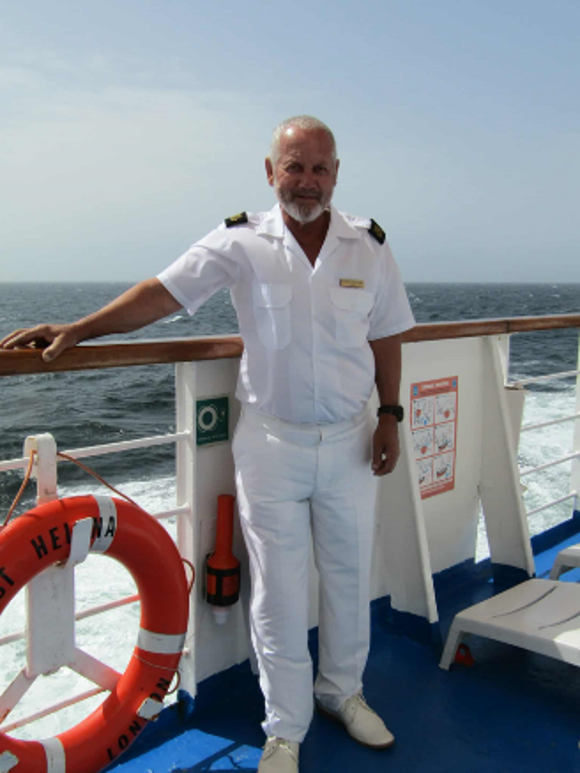
Mr Williams on the RMS St Helena
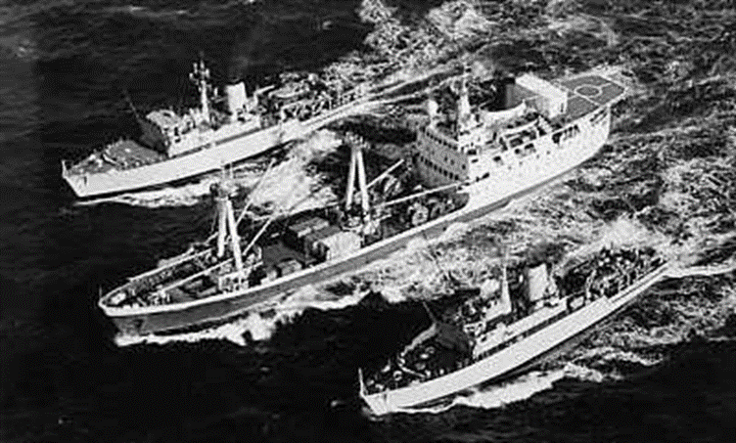
The RMS St Helena requisitioned to join the Falkland Task Force in 1982
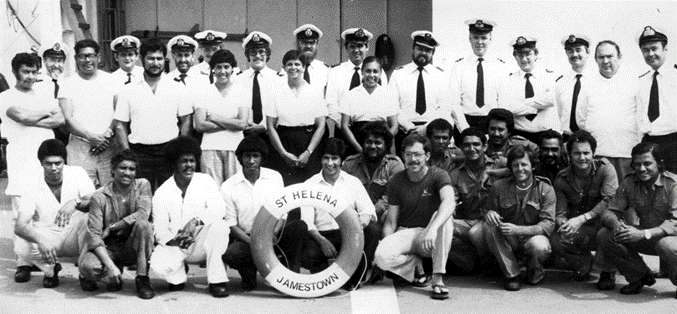
Members of the RMS St Helena crew with a younger Mr Williams kneeling second from the right
#StHelena #Maritime #DayoftheSeafarer