
Latest Posts
The St Helena Statistics Office has released new estimates for the total population of St Helena, and the number of births and deaths. At the end of June 2023 there were an estimated 4,252 people on the island, of which 4,148 were estimated to be residents. This is 32 lower than a year ago, when the estimated on-island population stood at 4,272, and residents numbered 4,180. There were also an estimated 104 visitors on St Helena at the end of June 2023, this represents a 28% decrease from the previous month of May (144), but is a 13% increase compared to a year ago (92).
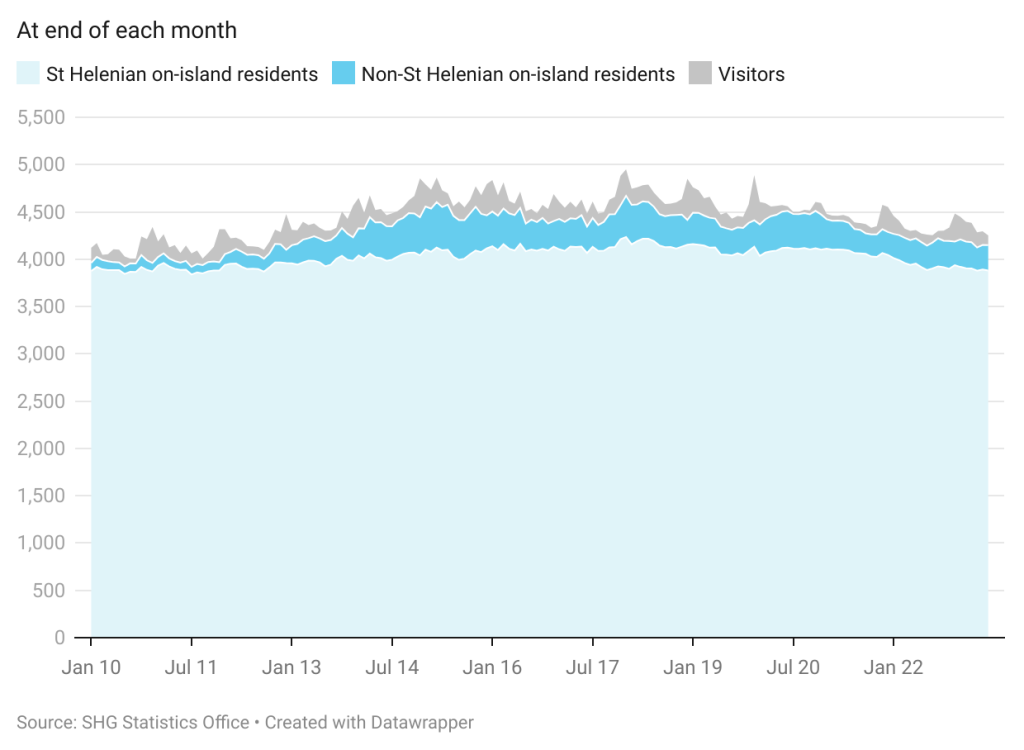
Compared to June 2022 there has been a decrease in the number of children living on the island (0-14 years) and those of roughly working age (15-64 years), by 6.7% and 0.9% respectively, but an increase in those 65 and over, by 2.7%. The Old Aged Dependency Ratio of the resident population (the number of those 65 and over compared to those of roughly working age) is estimated to be 45.1 at the end of June 2023, an increase compared to June 2022, when it was estimated to be 43.5.
Get the data
A data file in Excel format with statistics on population (population totals, arrivals, departures, births, deaths and the age and sex structure of the resident population) can be downloaded here.
The latest estimates have been released for the numbers of arrivals and departures to and from St Helena. In June 2023, there were a total of 231 arrivals, an increase of 72 arrivals compared to the same period in 2022 (159). Of these June 2023 arrivals, 200 arrived by air and the remaining 31 by sea; 88 people arrived for leisure, including tourists and St Helenians visiting family and friends on the island. There were an estimated 269 departures in June 2023, 38 more than the number of arrivals. Of these, 215 left by air and the remaining 54 by sea; compared to the same month a year ago this is an increase of 39%, or 75 departures.
Get the data
A data file in Excel format with detailed statistics on arrivals and departures can be downloaded here.
New estimates of the Retail Price Index and Inflation for Quarter 2, 2023
Estimates of the Retail Price Index and price inflation rates have been calculated for the second quarter of 2023. Detailed statistics in Excel format, including price indices and inflation rates by category of expenditure, can be downloaded here, and a PDF version of this Statistical Bulletin can be downloaded here.
About the Retail Price Index
The Retail Price Index (RPI) is a statistical measure of the change in retail prices on St Helena. An increase in the RPI means that, on average, prices have gone up since the last time they were measured, and a decrease in the RPI means that, on average, prices have fallen. It is important to understand that the RPI is an average measure: if it goes up, it does not mean that all prices have gone up, and similarly, if it goes down, it does not mean that all prices have fallen.
Latest index value and inflation rates
For the second quarter of 2023 the RPI has been measured at 115.3, an increase compared to the first quarter, when it was 114.8 (Chart 1).
Chart 1. Retail Price Index, Q2 2016 to Q2 2023

A year ago the RPI was 112.8, resulting in an annual inflation rate of 2.2%, comparing prices in the second quarter of 2023 to the same time period in 2022. The previous annual inflation rate (Q1 2023) was 5.4% (Chart 2).
Chart 2. Annual inflation rate, Q2 2016 to Q2 2023

Price changes in the last year
The index uses 203 representative items to measure price changes in nine different categories of household spending. Since a year ago, 81 items increased in price, 31 items decreased in price, and the price of 91 items remained unchanged. All categories within the index saw an increase over the past year, apart from Communications, which has remained unchanged, and the Transport and Household Energy categories.
Average prices over the year in the Clothing and Food categories rose the most, 5.8% and 5.6% respectively. Changes in stock and increases in the average prices of footwear contributed to the increase in the Clothing category, although the impact of these price changes on the overall index is quite small because Clothing has a low weight (1.1%). Food was impacted most by increases in oil-based products, including cooking oil, likely due to the continued effect of the conflict in Ukraine.
The decrease in the Transport category is a result of the recent fall in the price of Petrol and Diesel, compared to the price a year ago, even though the price of these two commodities is still relatively high compared to prices in 2021 – last year, in the second quarter of 2022, fuel prices rose by an average of 60% compared to prices in 2021.
Price changes in both the UK and South Africa have a strong impact on prices on St Helena, since the majority of goods imported to St Helena are purchased in those two countries. In May 2023, annual consumer price inflation in the UK was measured at 8.7% (UK Office for National Statistics) unchanged from April, and in South Africa it was measured at 6.3% (Statistics South Africa) down from 6.8% from April. Changes in the value of the Rand compared to the Pound also have an effect on the price of goods purchased in South Africa, and over the last twelve months the Pound has fluctuated around 21 Rand per Pound, peaking at around 23 Rand per Pound in June this year – in other words, the Pound is stronger against the Rand than it was in 2022. The impact of this is that goods from South Africa become slightly cheaper for St Helenian importers.
Price changes in the last quarter
Shorter-term changes in prices can be measured by comparing the index with its value in the last quarter, three months ago (i.e. with Q1 2023). These quarterly inflation rates are typically lower than the annual rates, since they measure price changes over a much shorter period. Between Q1 of 2023 and Q2 of 2023, average prices rose by 0.4%: 30 prices rose, 19 prices fell, and 154 prices remained unchanged.
On average, prices of items representing Clothing rose the most over the quarter, 6.3% between Q1 and Q2 of 2023, although prices within this category can be quite volatile (due to changes in the items stocked by retailers), and the weight of Clothing in the RPI is quite low, at 1.1%. Food rose by 1.3% compared to the previous quarter, with the two highest quarterly increases measured in representative items for fresh fruit and cooked meals. The Transport category saw the biggest fall in average prices over the quarter, with the same cause as the fall in the annual inflation rate, namely the recent decrease in both petrol and diesel prices in July 2023.
Some Frequently Asked Questions
What is price inflation?
Price inflation is the change in the average prices of goods and services over time. The rate of price inflation is calculated from the change in the RPI, which is the official measure of the average change in the prices of goods and services paid by consumers. The RPI is estimated each quarter, i.e. once every three months, and the rate of price inflation is usually quoted on an annual basis; that is, comparing price changes over a 12-month period. Prices and the RPI tend to go up, but they can occasionally go down – which is known as price deflation.
Why do we measure inflation?
An accurate measure of price inflation helps understand the extent and nature of the impact of price changes on the government, businesses, households and individuals. Inflation rates are often used in budgeting and accounting processes so that costs can be adjusted for the effect of price changes.
How is the RPI calculated?
The basis for the RPI is the average weekly cost of goods and services purchased by households on St Helena, sometimes called the RPI ‘shopping basket’. Items which households purchase more of, such as food, have the biggest share of the RPI basket. The current RPI uses a basket from the latest Household Expenditure Survey in 2017; prices representing the groups of items in the basket are collected every quarter, and the price of the total basket is compared to the price in the baseline period, the first quarter of 2018. By convention, the value of the basket in the baseline period is scaled to 100, and the RPI values are quoted in relation to that baseline. For example, an RPI value of 120 means that average prices have increased by 20 per cent compared to those recorded in the baseline period.
What happens when items are not available?
If an item of the ‘basket’ is not available then either the previous price will be carried forward from the previous quarter, or a suitable substitute item will be identified and an adjustment calculation made. Care is taken to ensure that this substitute item represents the item category and that it does not introduce error to the measurement of the RPI. An important principle is that price changes should reflect actual price increases and decreases, and not changes in the quality of items.
The latest statistical estimates have been revised and released for population and births and deaths for May 2023. Please note that this also includes a revision to the previously released estimates for May 2022 to May 2023.
At the end of May 2023, there were an estimated 4,295 people on the island, of which 4,158 were estimated to be residents. This is slightly less compared to the end of May 2022, when the estimated on island population stood at 4,309 and residents numbered 4,220.
There were also an estimated 137 visitors on St Helena at the end of May 2023, this represents a 13% decrease from the previous month of April (157) but is also a 54% increase compared to May 2022, a year ago (89).
In the last twelve months, there has been a decrease in the number of children (0-14 years) and those of roughly working age (15-64 years), by 5.6% and 2.0% respectively, but an increase in those 65 and over, by 2.0%. The Old Aged Dependency Ratio of the resident population (the number of those 65 and over compared to those of roughly working age) is estimated to be 45.0 at the end of May 2023, an increase compared to May 2022, when it was estimated to be 43.2.
Before 2000, the number of births each year exceeded the number of deaths. However, since then, the number of deaths has exceeded births in almost every year. In the last twelve months, there were 60 deaths and 13 births, including those that occurred off-island. In the first five months of 2023, there have been only three births, but 24 deaths.
Get the data
A data file in Excel format with statistics on population (arrivals, departures, births, deaths and resident population sex/age breakdowns) can be downloaded here.
The latest statistical updates have been released for Arrivals and Departures data on June 30, 2023. For the month of May 2023, there were a total of 287 arrivals, an increase of 109 arrivals compared to the same period in 2022 (178). Of these May 2023 arrivals, 237 arrived by air and the remaining 50 by sea. Leisure arrivals numbered 109.
Additional statistical series and indicators are available at https://www.sainthelena.gov.sh/st-helena/statistics/, as well as published statistical reports, including Statistical Bulletins.
We welcome comments and suggestions on any of the statistics published by the Statistics Office. Please email: statistics@sainthelena.gov.sh, call tel: 22138, or visit the office in person on the top floor of the Post Office Building, Jamestown.
New Statistical updates have been released on June 09, 2023 on
Benefits, up to May 2023
Exchange Rates, up to May 2023
Additional statistical series and indicators are available at https://www.sainthelena.gov.sh/st-helena/statistics/, and published statistical reports, as well as Statistical Bulletins, can be found on the relevant statistics pages of the SHG website: https://www.sainthelena.gov.sh/st-helena/statistics/reports/ and https://www.sainthelena.gov.sh/st-helena/statistics/bulletins/.
We welcome comments and suggestions on any of the statistics published by the Statistics Office. Please email: statistics@sainthelena.gov.sh, call tel: 22138, or visit the office in person on the top floor of the Post Office Building, Jamestown.
The latest statistical updates have been released for Arrivals and Departures data on June 06, 2023. For the month of April 2023, there were a total of 323 arrivals. This is more than twice the number of arrivals compared to the same period in 2022 (155). Of these April 2023 arrivals, 291 arrived by air and the remaining 32 by sea. Leisure arrivals numbered 199, the majority (68%) were non Saint Helenian tourist visitors.
Additional statistical series and indicators are available at https://www.sainthelena.gov.sh/st-helena/statistics/, as well as published statistical reports, including Statistical Bulletins.
We welcome comments and suggestions on any of the statistics published by the Statistics Office. Please email: statistics@sainthelena.gov.sh, call tel: 22138, or visit the office in person on the top floor of the Post Office Building, Jamestown.
The latest statistical updates have been released for population data on June 6, 2023. There were an estimated 4,327 people on the island at the end of April 2023, of which 4,171 were estimated to be resident, and 156 were visiting. The updated data file (in Excel format) can be downloaded here, and contains estimates of the number of people on St Helena in various categories.
Additional statistical series and indicators, and various statistical bulletins and reports, are available at https://www.sainthelena.gov.sh/st-helena/statistics/. We welcome comments and suggestions on any of the statistics published by the Statistics Office. Please email: statistics@sainthelena.gov.sh, call tel: 22138, or visit the office in person on the top floor of the Post Office Building, Jamestown.
New estimates of economic activity on St Helena for 2021/22
This Bulletin presents new estimates of Gross Domestic Product (GDP) and Gross National Income (GNI) for 2021/22. The statistics and indicators presented in this Bulletin can be downloaded in Excel format here, and a version of this Bulletin is available in PDF format here. Other statistics on the St Helena economy can be found at: www.sainthelena.gov.sh/statistics/the-economy.
Gross Domestic Product
Gross Domestic Product (GDP) is a key indicator of economic activity used around the world: on St Helena it measures the total value of all the goods and services produced on the island during a year. For 2021/22, GDP at market prices is estimated to be £39.0 million and the annual change in the volume of goods and services produced by the economy (i.e., the annual growth rate) was estimated to be -1.7%, a decrease in GDP in real terms.
Table 1. Estimates of Gross Domestic Product, 2015/16 to 2021/22, £ million
| 15/16 | 16/17 | 17/18 | 18/19 | 19/20 | 20/21 | 21/22 | |
| Current basic prices | 35.6 | 33.1 | 33.9 | 36.5 | 36.2 | 37.2 | 37.1 |
| Current market prices | 41.6 | 38.8 | 36.3 | 38.2 | 37.8 | 39.2 | 39.0 |
| Constant 21/22 market prices | .. | .. | 38.7 | 39.8 | 38.7 | 39.6 | 39.0 |
| Annual GDP growth rate | .. | .. | .. | 2.9% | -2.6% | 2.3% | -1.7% |
For some purposes, it is better to use a measure of GDP which is adjusted for the size of the population. For 2021/22 GDP per capita was estimated to be £8,850 per person, or $12,120 (Table 2). When inflation is taken into account GDP per capita increased slightly, by 0.6%, compared to 2020/21. Countries with similar GDP per capita in 2021 were the Russian Federation ($12,190), Bulgaria ($12,220) and Costa Rica ($12,470), which were all slightly higher, and Palau ($12,080), Malaysia ($11,110) and Nauru ($10,650), all of which were slightly lower. Source: World Bank.
Table 2. Estimates of Gross Domestic Product per capita, 2015/16 to 2021/22
| 15/16 | 16/17 | 17/18 | 18/19 | 19/20 | 20/21 | 21/22 | |
| GDP per capita (£, current) | 8,960 | 8,570 | 7,930 | 8,190 | 8,330 | 8,690 | 8,850 |
| GDP per capita (£, constant 21/22 prices) | .. | .. | 8,440 | 8,520 | 8,540 | 8,800 | 8,850 |
| Annual GDP per capita growth rate | .. | .. | .. | 0.9% | 0.2% | 3.0% | 0.6% |
| Estimate of total on-island population | 4,639 | 4,528 | 4,601 | 4,693 | 4,563 | 4,527 | 4,422 |
| GDP per capita ($, current) | 13,510 | 11,200 | 10,530 | 10,760 | 10,620 | 11,370 | 12,100 |
When inflation is taken into account, GDP per capita expressed in St Helena Pounds has been growing slightly over the last four years, from an estimated £8,440 per person in 2017/18 to an estimated £8,850 per person in 2021/22. But expressed in current US dollars, GDP per capita has dropped from its 2015/16 level of $13,510 to $12,200 in 2021/22 – this is mainly due to the drop in the value of the pound compared to the dollar caused by the exit of the UK from the European Union (‘Brexit’).
Breakdown of value added by industrial activity
Table 3 shows the share of total value added by each major activity grouping (industrial activities are classified according to Revision 4 of the UN International Standard Industrial Classification, grouped to avoid disclosure of information about individual companies). Value added is the key component of GDP, and represents the total output of sole traders, businesses, government, and non-profit organisations, less the value of intermediate consumption. Intermediate consumption is the value of goods and services used in the process of producing final goods or services.
Table 3. Value Added by Industrial Activity, 2021/22
| GVA, £m | Share (%) | |
| A: Agriculture, Forestry and Fishing | 0.26 | 0.7 |
| B-E: Quarrying, Manufacturing, Electricity, Water, and Sanitation | 2.78 | 7.5 |
| F: Construction | 1.16 | 3.1 |
| G: Wholesale and Retail Trade; Repair of Motor Vehicles | 4.94 | 13.3 |
| H: Transportation and Storage | 1.53 | 4.1 |
| I: Accommodation and Food Service Activities | 0.51 | 1.4 |
| J-K: Finance, Insurance, Information, Communication | 6.14 | 16.5 |
| L: Real Estate Activities | 1.88 | 5.1 |
| M, N, R, S: Other Activities and Services, excluding Government | 1.16 | 3.1 |
| O-Q: Government, Public Administration, Health and Education | 16.74 | 45.1 |
| Total | 37.10 | 100.0 |
Apart from Government and Public Administration, which accounted for 45.1% of total value added in 2021/22, the largest groups were Finance, Insurance, Information and Communication (16.5%) and Wholesale and Retail Trade, including Repair of Motor Vehicles (13.3%). Production activities, including Quarrying, Manufacturing, Electricity, Water, and Sanitation, contributed around 7.5% of total value added in 2021/22, with Real Estate Activities (including rental properties and the value of owner-occupied housing) at 5.1% and Transportation and Storage (which includes the Airport) around 4.1%.
Chart 1. Value added by industrial activity, 2020/21 and 2021/22, constant 21/22 prices
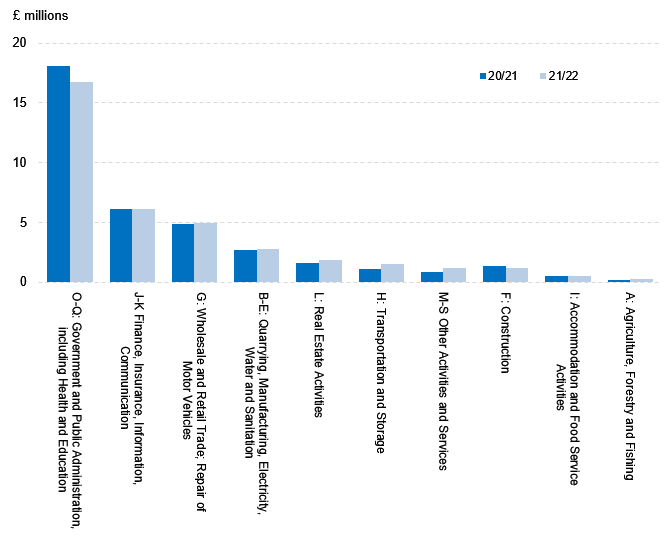
Chart 1 shows value added by each major industry group in 2020/21 and 2021/22. The biggest change was in Government and Public Administration (including Health and Education), which fell by around £1.3 million. One explanation of this fall is that the Government budget was increased in 2020/21 to mitigate the effects of the COVID-19 pandemic, including through the conversion of Bradley’s Camp into a quarantine and hospital facility, and support for those businesses most affected by the lower numbers of people visiting the island. Most of those costs were not sustained in 2021/22, leading to a lower budget and lower value added for the Government and Public Administration sector.
Gross National Income
A useful alternative measure to GDP is called Gross National Income (GNI), which values the economic activity of the Island’s residents, regardless of where that activity takes place. This is different to GDP, which is a measure of the total value of goods and services produced within the territorial boundaries of St Helena, regardless of whether that value is produced by its residents. GNI is derived from GDP by adding income earned abroad by residents and deducting income earned on St Helena by non-residents.
Table 4. Gross National Income, 2015/16 to 2021/22
| 15/16 | 16/17 | 17/18 | 18/19 | 19/20 | 20/21 | 21/22 | |
| Current market prices (£ million) | 36.7 | 35.7 | 34.9 | 37.6 | 37.6 | 39.7 | 39.2 |
| Per capita, current prices, £ | 7,910 | 7,890 | 7,590 | 8,010 | 8,230 | 8,770 | 8,870 |
| Per capita, current prices, $ | 11,930 | 10,320 | 10,070 | 10,520 | 10,490 | 11,470 | 12,120 |
| OECD aid threshold $ | 12,475 | 12,235 | 12,055 | 12,375 | 12,535 | 12,695 | 13,205 |
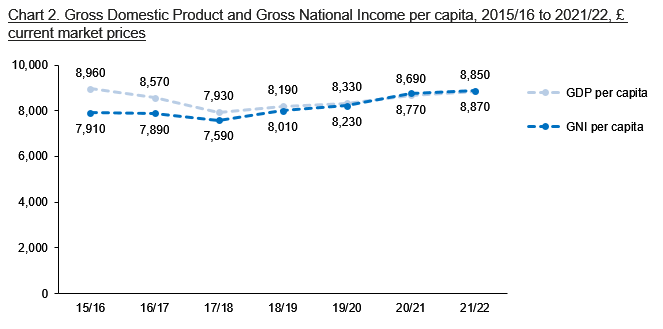
Table 4 shows the nominal levels of GNI per capita since 2015/16 and Chart 2 compares GNI per capita with GDP per capita between 2015/16 and 2021/22. GDP per capita was higher than GNI per capita until 2020/21; the difference between the two has narrowed as the construction work to build St Helena Airport came to an end, around 2017.
Chart 2. Gross Domestic Product and Gross National Income per capita, 2015/16 to 2021/22, £ current market prices
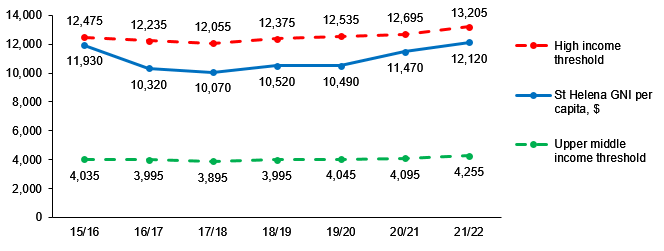
An important use of GNI per capita is to determine whether resource flows from one government to another can be classified as ‘Official Development Assistance’ by the Organisation of Economic Cooperation and Development (OECD); such flows are also often simply called ‘overseas aid’. The rule is that they can, as long as the country receiving those flows is classed as a low, lower-middle, or upper middle income country by the World Bank in at least one of the three years prior to the point at which the determination is made. The classification threshold used by the World Bank to classify countries as high income or upper middle income are adjusted each year, and are shown in Chart 3.
St Helena’s GNI per capita level means that it currently falls into the ‘upper middle income’ country classification, so the financial flows it receives from the United Kingdom and other official aid donors can be classified as Official Development Assistance. It was close to the high income threshold in 2015/16, when the new Airport construction was underway, but the threshold is calculated in US dollars and the fall in value of the Pound that followed the Brexit vote widened the gap in 16/17 and in subsequent years. However, the gap has narrowed again in 2020/21 and 2021/22, in part because the overseas earnings of the deposits of the Bank of St Helena increased significantly (and those earnings are included in GNI but not in GDP), and in part because the value of the Pound has strengthened slightly compared to the US dollar.
Chart 3. Gross National Income per capita and World Bank High Income and Upper Middle Income classification thresholds, 2015/16 to 2021/22, $ current market prices
Notes and Methodology
Revisions: GDP estimation and measurement methods are complex and development of St Helena’s National Accounts is an ongoing programme of work. All estimates published in this bulletin should be considered provisional and subject to future revision as additional data sources become available and further improvements are made to the methodology.
Approach: There are three basic methods of compiling total GDP: the expenditure, income, and production (or output) approaches. Prior to 2016, St Helena published estimates based on the expenditure approach, and in 2016 a figure for 2014/15 was published based on the income approach. This Bulletin presents estimates based on the production approach. As far as practicable in a small economy with limited resources for compiling GDP statistics, the methods used aim to follow the international guidance published in the ‘2008 System of National Accounts’ by the United Nations.
GDP at basic prices: Estimates at basic prices are derived as the sum of the gross value added of companies and government consumption expenditure, plus the incomes of sole traders, and an estimate of the rental value derived by households from the owner-occupation of their homes. The valuation of the output of government has been made on a net basis, excluding an estimate of asset depreciation (this is common in other small countries). Taxes on production are small and have not generally been included, so the value of GDP at basic prices is roughly equivalent to factor cost.
GDP at market prices: GDP at market prices is derived by adding total indirect taxes on products and production (including customs duties and service taxes) to total GDP at basic prices, and subtracting regular government subsidies to companies. This is consistent with the recommendations in the guidelines issued by the United Nations.
Inflation adjustment: Estimates are presented in both nominal and real terms, referred to in this bulletin as current prices and constant 2021/22 prices. Estimates in nominal terms will change due to both the effect of price changes and because of growth in the size of the economy. But changes in the size of the economy can only be measured using estimates expressed in real terms, adjusted for price inflation. Estimates in real terms have been calculated using the recommended method of using specific inflation estimates for each industrial grouping of economic activity, an improvement on past practice of using St Helena’s Retail Price Index.
Measurement issues: There are significant measurement difficulties in obtaining accurate source data for estimating GDP and related indicators for St Helena. Additionally the recommended measurement frameworks and concepts are not always well suited to measuring economic activity in small, aid-dependent economies. Estimates are very sensitive to timing issues and to recording or classification conventions, which while appropriate for larger economies may distort trends and levels in smaller countries. There are further measurement difficulties in calculating GNI; in particular, there are very limited data sources to estimate the income earned abroad by resident individuals and companies and the income earned on St Helena by non-resident individuals and companies.
Per capita estimates: For calculating per capita estimates of GDP and GNI, the population total used is the average of the end of month on-Island population estimates for the period, as published on the St Helena Government website by the Statistics Office.
Currency conversion: For converting from St Helena Pounds (£) to United States Dollars ($), the average daily spot rates published by the Bank of England have been used, based on an average for each financial year.
Data sources: The primary sources that have been used to compile GDP and related measures include Business Surveys conducted by the Statistics Office, Income Tax returns, published company accounts, and population estimates published by the Statistics Office. Thanks are extended to all the companies and businesses that have responded to past Business Surveys, and to the Income Tax Office for their cooperation and help in using the data from tax returns for this purpose. Data confidentiality is maintained in accordance with the requirements of the 2000 Statistics Ordinance.
Technical advice and support: Compiling estimates of Gross Domestic Product and related National Accounts is a highly specialised task that has only been possible because of the technical advice and support provided by the Office of National Statistics (ONS) Methodology Advisory Service in the United Kingdom – thanks are especially due to Jim O’Donoghue and Robin Youll.
Have more questions or comments?
Please get in touch: we are Neil Fantom, Chief Statistician, and Kelly Clingham and Justine Joshua, Senior Statistical Assistants. You can find us in person at the Statistics Office on the top floor of the Post Office Building, Jamestown. You can also contact us by telephone on 22138; if calling from overseas, the international dialling code for St Helena is 290. Our general office e-mail address is statistics@sainthelena.gov.sh, or you can email team members directly (the format is firstname.lastname@sainthelena.gov.sh).
A Statistical update has been released on May 24, 2023 on
Ascension & Tristan Da Cunha Population, up to Quarter 1 2023
Additional statistical series and indicators are available at https://www.sainthelena.gov.sh/st-helena/statistics/, and published statistical reports, as well as Statistical Bulletins, can be found on the relevant statistics pages of the SHG website: https://www.sainthelena.gov.sh/st-helena/statistics/reports/ and https://www.sainthelena.gov.sh/st-helena/statistics/bulletins/.
We welcome comments and suggestions on any of the statistics published by the Statistics Office. Please email: statistics@sainthelena.gov.sh, call tel: 22138, or visit the office in person on the top floor of the Post Office Building, Jamestown.