Today the government is launching a consultation on possible changes to St Helena’s income tax on employment and self-employment income as a part of a package of reforms designed to assist with the rising cost of living.
The current system
If you are eligible for a personal allowance, you do not pay income tax on the first £7,000 you earn each year. You pay 26% tax on the part of your earnings between £7,000 and £25,000, and 31% on any earnings above £25,000.
This does not mean that all your earnings are taxed at a higher rate when you earn more than £25,000. You only pay the higher rate on the amount you earn above £25,000. This means that as your earnings increase, so does your take-home pay, after income tax.
The key issues
Government recognises the pressures that the rising cost of living places on individuals and families. The Government wants to support people and cutting income tax could boost people’s take home pay. However, income tax receipts funds valuable public services like health and education, and a large cut to income tax would lead to cuts in public services.
To support people on lower incomes, the Government is consulting on possible changes to income tax. To avoid cutting public services, the options include the possibility of raising income tax on higher earners, so that the options do not change government revenue substantially.
The consultation sets out five possible changes to income tax and one “do nothing” option. The key differences between the options are who gains, by how much, and how large the tax increase is for those on higher incomes. The main choices are how much relief to offer, where to concentrate it, and how widely to spread the additional tax burden.
Issues informing the decision
The seven issues examined are government revenue; disposable income; income distribution; incentives to work and live in St Helena; work and investment incentives; sector-specific impacts; and tax policy design. Around four in five taxpayers earn below £20,000, but most income tax is raised from those earning above that level.
Higher tax rates could affect recruitment, retention, overtime, second jobs and entrepreneurship. Effects may differ across sectors and depend on competing salary and tax packages elsewhere. The assessment uses four criteria: impact on revenue, support for government objectives, impact on inequality, and ease of administration. Higher revenue and lower inequality are treated positively, while the appropriate balance is explicitly recognised as a political judgement.
Consultation and implementation
These options would impact different groups in different ways and we are keen to hear views on these options. In particular, we would like to hear about how people might change their behaviour if any of these options were introduced. There will be a series of consultation events reaching out to the different groups affected by the possible changes. This will include targeted engagement with the Chamber of Commerce, individual private companies, employee representatives, and other relevant stakeholders, while ensuring that all members of the public, including individuals and groups who may be affected by the proposed changes, have a reasonable and accessible opportunity to participate and provide their views.
This release marks the beginning of a public consultation period, which will run from 25 November 2026 to 23 December 2026.
A questionnaire and submission form for responses is available here, or at the link provided by the following QR code.

All responses to the questionnaire are completely anonymous and will be used to inform policy decisions. The questionnaire will take approximately 10 minutes, and a text box is available at the end to provide open-ended responses. The questionnaire will also be made available in hard copy at the public library and the Customer Services Centre at the Post Office. Completed questionnaires can be submitted at either the Post Office or the Public Library.
Alternatively, please email katy.peters@sainthelena.gov.sh or matthew.johnson@sainthelena.gov.sh or visit the dedicated stall outside the Canister in Jamestown between 12:00 and 14:00 on Thursdays: 3 December, 10 December, and 17 December. Further details on the targeted consultation and drop in sessions will be published shortly.
Policy options and consultation direction
The policy options are set out below.
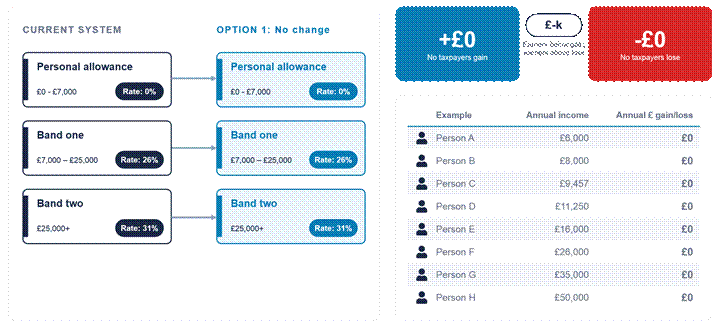
Option 1 — Continue the current situation. Keep the existing bands and rates, with no revenue change. This option would not provide any additional tax relief. As nominal wages increase over time, more people would pay income tax, even if tax rates remain unchanged.
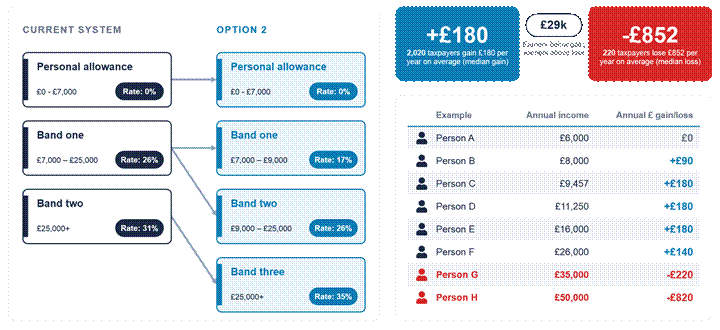
Option 2 — Introduce a lower band with a rate of 17% up to £9,000. Under this option there would be a lower tax rate of 17% on income between £7,000–£9,000, 26% on £9,000–£25,000 and 35% above £25,000. Many taxpayers would gain exactly £180 annually; the income at which people would have a higher tax bill is around £29,000. SHG loses some revenue under this option.
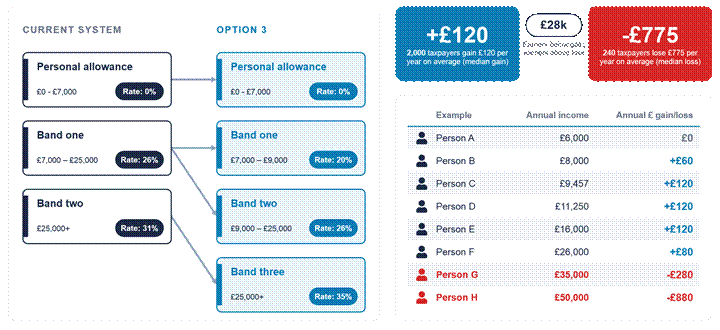
Option 3 — Introduce a lower band with a rate of 20% up to £9,000. Income between £7,000 – £9,000 would be taxed at 20% under this option, the 26% rate would be retained up to £25,000 and the top rate increased to 35%. Many taxpayers gain £120 annually, with a reported breakeven around £28,000. This option raises a small amount of money for SHG.
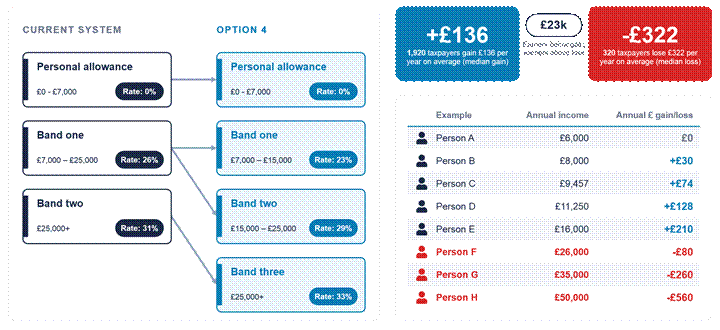
Option 4 — Introduce a lower band with a rate of 23% up to £15,000. Income between £7,000 and £15,000 would be taxed at 23%, income between £15,000–£25,000 would be taxed at 29%, and the top rate would rise to 33% on incomes above £25,000. Gains peak at earnings of £15,000; those above around £23,000 pay more.
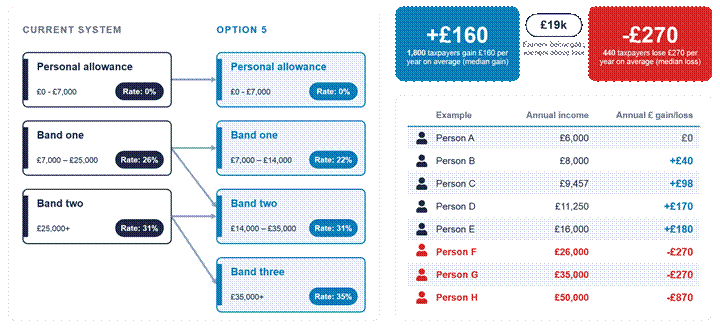
Option 5 — Split the first income tax band and make the highest marginal income tax rate payable after £35,000. A rate of 22% is applied on £7,000–£14,000, 31% on £14,000–£35,000 and 35% above £35,000. Gains peak at £14,000.
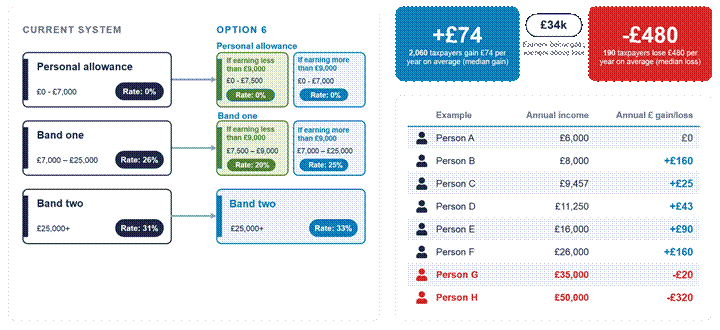
Option 6 — Different personal allowances and lower tax bracket for different incomes. Under this option there would be a £7,500 allowance and 20% lower band for those with income below £9,000, with 25% on income between £7,000 and £25,000 for other earners and 33% above £25,000. The breakeven income is around £34,000. This option concentrates benefits within the £7,000 to £9,000 a year group; however, it creates a cliff-edge whereby those earning just over £9,000 take-home less pay than those earning just under £9,000.
#StHelena #IncomeTax #PublicConsultation