What is Marine Enforcement and Why Is It Important?
Marine enforcement is the process of ensuring that marine laws and regulations are followed to protect our ocean resources for current and future generations. It plays a vital role in maintaining sustainable fisheries, safeguarding marine biodiversity, and supporting our local community whose livelihoods depend on the ocean.
Effective enforcement helps prevent illegal, unreported, and unregulated (IUU) fishing and ensures that marine activities remain within the legal framework designed to conserve the marine environment.
The Environment, Natural Resources and Planning portfolio’s Marine Compliance and Enforcement (MC&E) section have legal powers delegated to them by the Chief Fisheries Officer, to enforce legislation, under the Fisheries Ordinance 2021.
Some of the main responsibilities of the MC&E section include:
- The issuing and enforcement of licenses and their conditions for fishing and fishing related activities.
- The monitoring, control and surveillance of fishing and fishing related activities, including both inshore and offshore areas.
- To enforce the provisions to preserve fisheries resources and stocks within St Helena.
- To enforce conservation management measures within St Helena’s MPA.
And, some of their delegated powers include:
- To inspect any marine installation.
- To board and inspect vessels.
- Power of seizure where or whenever necessary.
- To conduct any searches or examinations.
Meet the Team
Our Marine Compliance and Enforcement section is made up of a Marine Enforcement Officer and, a Marine Compliance and Enforcement Officer. They are trained professionals dedicated to protecting the marine environment. With experience in fisheries management, maritime operations, and compliance monitoring, the team works both on land and at sea to uphold regulations.
We collaborate closely with stakeholders, including local fishers, conservation, and international organisations, to ensure that marine resources are managed responsibly and legally.
What Do We Do?
Our primary mission is to enforce marine regulations to protect the marine environment and promote sustainable use of our ocean resources.
We do this by:
Issuing Fishing Licences – there are three main types of licences:
- Commercial fishing licence: allows the licence holder, along with the vessel’s master and crew (whether employed or self-employed), to fish from the vessel. “Commercial fishing” refers to fishing for the purpose of selling, trading, or otherwise gaining profit or reward from the catch.
- Recreational fishing licence: allows the licence holder, the vessel’s master, and any passengers to fish from that vessel. However, the licence does not permit fishing by paying passengers or clients on board.
- Sports fishing licence: allows the licence holder, their paying clients, as well as the vessel’s master and crew, to fish from the specified vessel or vessels.
- On-island monitoring of compliance by assessing whether fishers are following the conditions of their licences through various monitoring activities:
- Fish Landing Checks
- Boarding Inspections
- Sea Patrols
- Observer Trips
- Reviewing Fishing Logbooks
These activities help us ensure that fishers are reporting accurately and operating within legal boundaries.
Offshore Monitoring
In addition to on-island efforts, offshore compliance is a key part of our work. Through the Blue Belt Programme and in collaboration with the Marine Management Organisation (MMO), MC&E monitors ‘Big Ocean Data’ to identify vessels fishing just outside our Exclusive Economic Zone (EEZ). We share this information with the MMO, who conduct further monitoring to ensure these vessels do not cross into and fish within our EEZ. Our offshore surveillance and enforcement activities like satellite monitoring, data analysis, and joint operations help to detect and deter illegal fishing in our waters.
IMPORTANT INFORMATION
Total Allowable Catch (TAC) limits
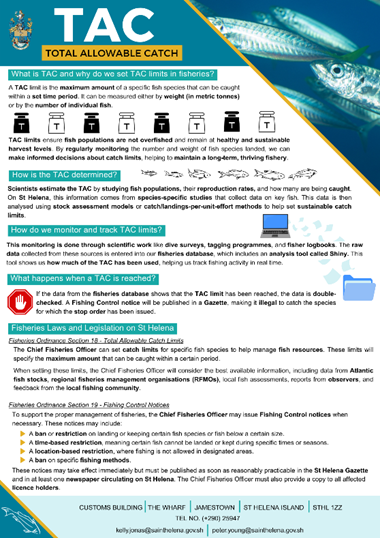
Scientists use data on fish populations, reproduction, and catches to estimate the Total Allowable Catch (TAC) — the maximum amount of a fish species that can be caught within a set period. On St Helena, this data comes from studies, surveys, tagging, and fisher logbooks, which are analysed in a fisheries database to track catches in real time.
TAC limits help prevent overfishing and keep stocks sustainable. When monitoring shows a TAC has been reached, the data is verified and a Fishing Control notice is issued, making it illegal to catch that species until further notice.
Fisheries Ordinance Section 18 – Total Allowable Catch Limits
The Chief Fisheries Officer can set catch limits for specific fish species to help manage fish resources. These limits will specify the maximum amount that can be caught within a certain period.
When setting these limits, the Chief Fisheries Officer will consider the best available information, including data from Atlantic fish stocks, regional fisheries management organisations (RFMOs), local fish assessments, reports from observers, and feedback from the local fishing community.
Fishing Control Notices
Fisheries Ordinance Section 19 – Fishing Control Notices
To support the proper management of fisheries, the Chief Fisheries Officer may issue Fishing Control notices when necessary. These notices may include:
- A ban or restriction on landing or keeping certain fish species or fish below a certain size.
- A time-based restriction, meaning certain fish cannot be landed or kept during specific times or seasons.
- A location-based restriction, where fishing is not allowed in designated areas.
- A ban on specific fishing methods.
These notices may take effect immediately but must be published as soon as reasonably practicable in the St Helena Gazette and in at least one newspaper circulating on St Helena. The Chief Fisheries Officer must also provide a copy to all affected licence holders.
Current Fishing Control Notices include:
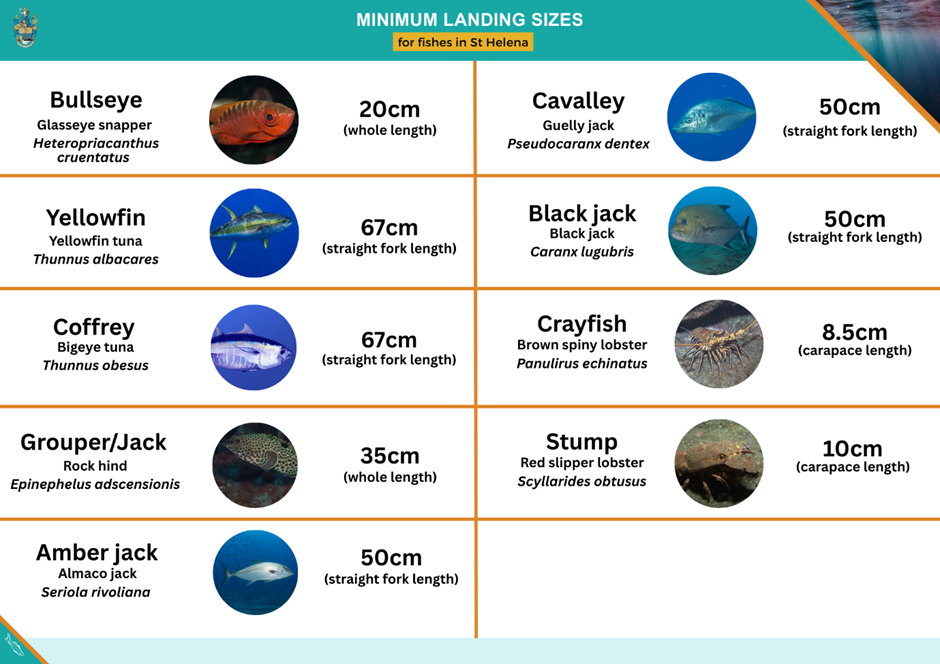
Minimum Landing Sizes
Closed Seasons and Restrictions
The following lists all restricted activities within St Helena’s waters.
It is illegal to:
- Fish within 100m of any wreck, unless for bait.
- Spearfish within 100m of any wreck.
- Catch lobster from, 1st October to the 31st December.
- Catch lobster by any other method then pots during 1st Jan to the 31st March.
- Use droppers between 1st Jan and the 17th March (unless in possession of a valid commercial fishing license for the capture of bait-fish only).
- Spearfish from 1st Jan to the 31st March.
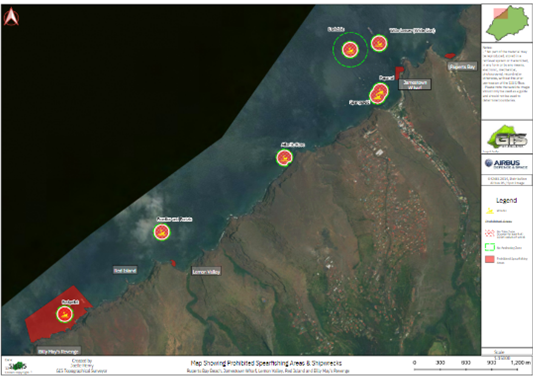
Spearfish at Rupert’s Bay, Jamestown Wharf, Lemon Valley, Red Island or Billy May’s Revenge.
Working Together for a Sustainable Ocean
By enforcing marine laws, monitoring compliance, and working with local and international partners, the Marine Compliance and Enforcement team helps ensure that our marine resources are protected for generations to come.
Have questions or need more information? Contact us on;
Email: kelly.jonas@sainthelena.gov.sh or peter.young@sainthelena.gov.sh
Tel no: (+290)25947 or 64642