
This update releases new estimates of gross annual incomes of full-time employees (i.e. wages) for the 2024/25 financial year, with comparable estimates for previous years from 2013/14 onwards. To download the full dataset in Excel format, please click here.
These estimates measure gross before-tax incomes of persons in regular full-time employment on St Helena, reported through the Pay-As-You-Earn tax collection system. They exclude company and self-employment incomes, incomes of Technical Cooperation (TC) Officers of the St Helena Government, investment income, Income Related Benefits, incomes from pensions (including the Basic Island Pension), and part-time and part-year incomes, all as far as they can be identified in the dataset. All annual estimates are rounded to the nearest £10.
Median wage levels, adjusted for inflation
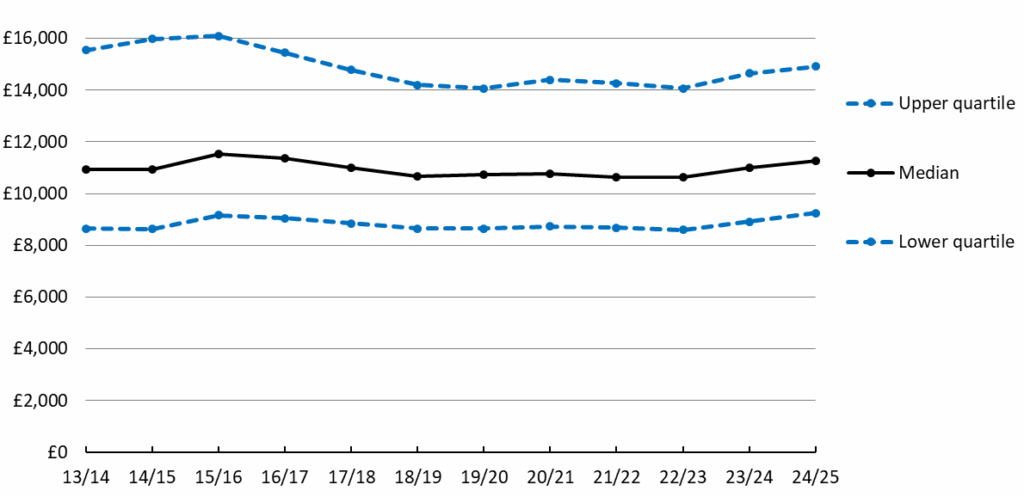
The median annual wage on St Helena in 2024/25 is estimated to be £11,250, in 2024/25 prices. When price inflation is taken into account, this is 2.2% higher than the median wage in 2023/24 (Chart 1).
Chart 1. Annual gross wages from full-time employment: median and upper and lower quartiles, 2013/14 to 2024/25 (inflation-adjusted 2024/25 prices)
The median is the usual measure of average incomes or wages because it is less sensitive to small numbers of relatively high wage earners in a population than the mean, which is the more common method used in other statistics. A median wage level of £11,250 means that, for 2024/25, half the people earning full-time wages from non-TC employment had gross wages that were less than £11,250, and half had gross wages that were higher.
Wage level range
Chart 1 also shows the upper and lower quartiles; the lower quartile is the point at which a quarter of wages are lower, and the upper quartile is the point at which a quarter of wages are higher; half of all employment wages lie between the lower and upper quartiles. For 2024/25, half of all full-time employees earned between £9,240 and £14,920. Median incomes are also reported for each decile in the dataset; each decile includes one tenth of all incomes, from the lowest to the highest.
Differences in wage levels between women and men
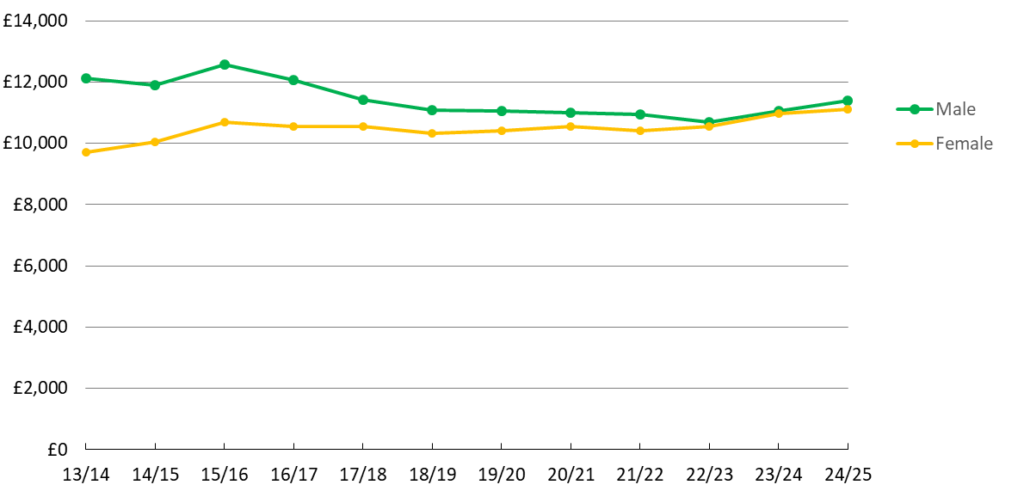
Chart 2 shows inflation-adjusted median wages from employment broken down by male and female employees, between 2013/14 and 2024/25. For every year, the male median wage has been higher than the female median wage but the gap has narrowed in recent years; in 2013/14 female wages were 80.3% of male wages, but in 2024/25 this was 97.5%.
Chart 2. Median real gross annual wages from employment, male and female 2013/14 to 2024/25, in constant 2024/25 prices (i.e. adjusted for inflation)
Average wage levels by occupation
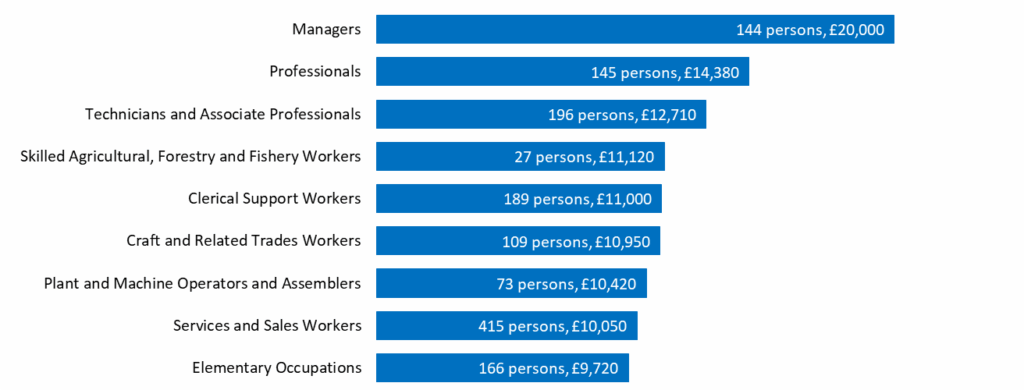
Employees have been classified into their main occupational grouping using the International Standard Classification of Occupations published by the United Nations (International Labour Organisation). Chart 3 shows estimates of median wages in each of these major groupings, for 2024/25, excluding TC Officers and eight persons that could not be classified.
The groups of occupations with the highest wages, on average, were Managers, Professionals, and Technicians and Associate Professionals. These groups accounted for 485 employees, or 33% of non-TC employees. The occupations with the lowest wages, on average, were Plant and Machine Operators and Assemblers, Services and Sales Workers, and Elementary Occupations (this group includes unskilled labourers). These groups accounted for 654 employees, or 44% of non-TC Officers.
Chart 3. Median gross annual wages from employment by occupational grouping, 2024/25
Average wage levels by industry
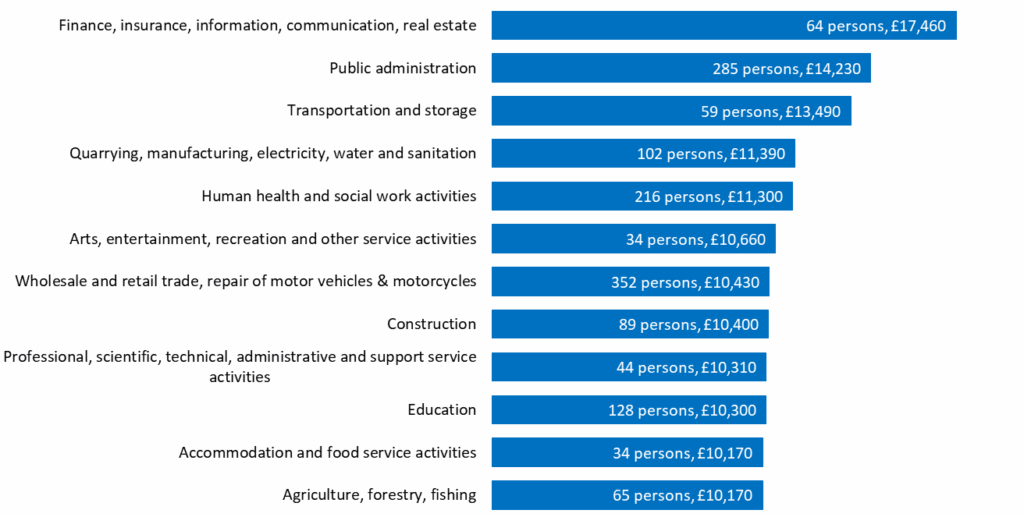
Employees have also been classified into their main industry grouping using the International Standard Industrial Classification published by the United Nations. Industries differ from occupations, since they indicate the principle economic activity to which each employee contributes; mainly, the classification by industry derives from employers. Chart 4 shows estimates of median wages in each major grouping, for non-TC employees.
In 2024/25 the three groups of industries with the highest wages, on average, were Finance, Insurance, Information, Communication and Real Estate, Public Administration, and Transportation and Storage. The three groups of industries with the lowest wages, on average, were Professional, Scientific, Technical, Administrative and Support Service Activities, Education, Accommodation and Food Service Activities, and Agriculture, Forestry, and Fishing.
Chart 4. Median gross annual wages from employment by industry, 2024/25
Numbers of persons in full-time employment
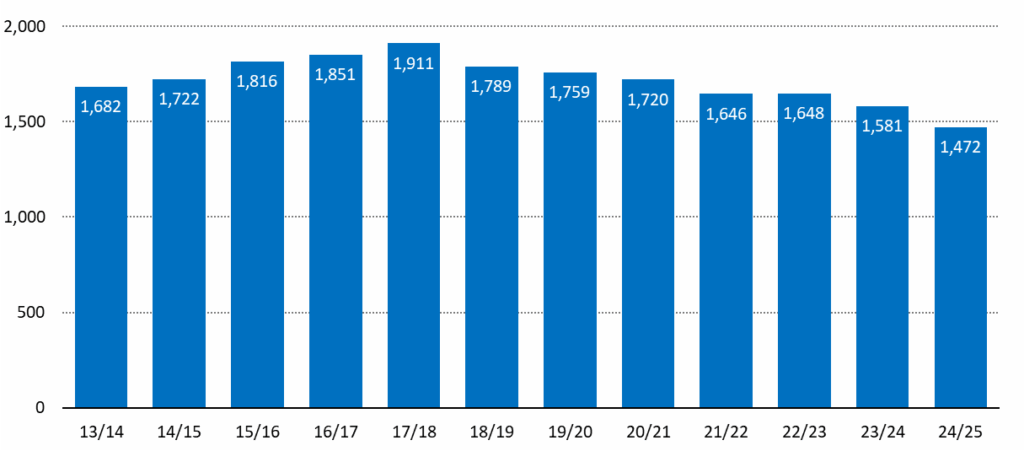
Chart 5 shows the number of persons with wages from full-time employment. The total estimated number of persons with wages from full-time employment rose to 1,911 in 2017/18, the year when the new airport was opened and most construction activities were completed. Since then, the number has tended to fall slightly each year; in 2024/25 there were an estimated 1,472 persons with wages from full-time employment, a drop of 23% compared to 2017/18.
Chart 5. Number of employees in full-time employment, 2013/14 to 2024/25
Methodology, data, and questions or comments
The complete set of statistics on average gross incomes from employment from 2013/14 to 2024/25 is available here in Excel format. For details on how these estimates are computed, please click here. And to contact us with questions, comments, or to request alternative data formats, please click here.