
Latest Posts
The St Helena Government (SHG) Roads Section has received questions from members of the public about which roads SHG is responsible for maintaining, how repair work is prioritised, and why some roads receive attention before others. To help the community understand how the island’s road network is managed, SHG is setting out how roads on St Helena are classified, and what the Roads Section’s maintenance budget allows it to do.
Understanding the difference between adopted (Government) and un-adopted (non- Government) roads, and between primary, secondary and tertiary roads, explains how maintenance decisions are made and why SHG’s resources are focused where they are.
There are two categories of roads on St Helena:
- Government (Adopted roads)
- Non-government (Un-adopted roads)
Each of these categories can be broken down further as in Table 1.
Table 1: Categories of Roads
| Government (Adopted roads) | Highway | Primary roads | 34144 | meters |
| Secondary roads | 36581 | meters | ||
| Tertiary roads | 44338 | meters | ||
| Non-Government (Un-adopted roads) | District Private on Crown LandPrivate on Private Land | |||
| Community | ||||
Road Definitions & Classifications
Government (Adopted) Roads
Primary roads serve the main centres of population, the main industrial / commercial areas and a ring road connecting the main areas of the island. These roads are used by the most people and carries the most volume of traffic on island. It is also the highest priority when the reactive maintenance plan is formulated. E.g. Side Path Road, Ladder Hill Road
- Secondary roads serve the various communities distributed around the island as well as areas of industry, commerce and agriculture. These roads are at lower maintenance priority than primary roads. E.g. Evergreen Drive in Half Tree Hollow
Tertiary roads are all other surfaced roads maintained by SHG including roads provided as part of the serviced house plots and serve small clusters of 3 to 6 properties or individual accesses. These roads are at the lowest end of priority when
the reactive maintenance plan is formulated.
Non-Government (Un-adopted) Roads
- District Roads: Roads that provide access to individual parcels of land or specific plots. These are classified legally based on land tenure:
- a) Private on Crown Land: Un-adopted roads situated on Crown land used to access leased or allocated plots.
- b) Private on Private Land: Un-adopted roads situated entirely on privately owned land.
- Community Roads: Un-adopted roads that provide shared access to multiple homes, residential clusters, or community facilities. While these roads are not maintained under SHG’s recurrent maintenance budget, they represent shared neighbourhood access routes used by multiple households. E.g. Sapper Way.
Maintenance Strategy and Resource Allocation
To maximise public safety and road efficiency within the available recurrent annual budget, the SHG Roads Section focuses primary efforts on reactive and emergency maintenance across the 115 km adopted road network. Monthly inspections of all adopted roads are conducted to identify hazards and schedule necessary reactive work, with primary roads taking precedence due to high traffic volumes.
There is currently no recurrent budget for long-term proactive or planned maintenance, nor is there funding to undertake work on un-adopted roads (including private roads on the Crown Estate or private land). Under current recurrent funding levels, the budget only allows for approximately 2.5 to 3 km of reactive maintenance across the entire 115 km adopted network each year.
Capital Projects vs. Recurrent Maintenance
Members of the public may have noticed major road resurfacing works completed across the island last year. Please note that these major resurfacing works were capital improvements funded through the Economic Development Investment Programme (EDIP), rather than SHG’s recurrent annual maintenance budget. Recurrent maintenance funding remains strictly limited to essential reactive and emergency repairs on adopted public roads.
Recurrent Budget Limitations
To maximise public safety and road efficiency within available annual funding, the SHG Roads Section focuses its recurrent resources exclusively on reactive and emergency repairs across the 115 km adopted road network. Monthly inspections of all adopted roads are conducted to identify hazards and schedule necessary reactive work, with primary roads taking precedence due to high traffic volumes.
There is currently no recurrent budget for long-term proactive or planned maintenance, nor is there funding to undertake work on un-adopted roads (including private roads on the Crown Estate or private land). Under current recurrent funding levels, the budget only allows for approximately 2.5 to 3 km of reactive maintenance across the entire 115 km adopted network each year.
#StHelena #StHelenaGovernment #RoadClassification
The Post and Customer Services Centre (PCSC) reminds all licence holders to check the expiry dates of their annual licences.
The PCSC has noted an increase in overdue vehicle/MOT licences, driver’s licences and dog licences. Licence holders are responsible for monitoring renewal dates and ensuring their licences remain valid.
Driving an unlicensed vehicle, driving with an expired driver’s licence or keeping an unlicensed dog are serious legal infractions. If your licence has expired, please visit the PCSC to renew it without delay.
Licences may be renewed up to three months before expiry. For example, a licence expiring on 1 November may be renewed from 1 August. The renewed licence will take effect from its original expiry date of 1 November.
Thanks are extended to all licence holders for their prompt co-operation in keeping the community safe and officially registered.
The Health and Social Care Portfolio will deliver a bowel cancer screening programme for adults aged 50 to 74 this November and December, ahead of a visiting specialist’s arrival in January 2027.
Collect your test kit from your nearest health clinic from November.
Why screening matters
Bowel cancer (also known as colorectal cancer) is cancer found anywhere in the large bowel. It is the third most common cancer worldwide, and in the UK it is the second largest cause of cancer deaths. Several people are diagnosed in St Helena every year.
Screening looks for early signs of disease in people with no symptoms. It aims to find bowel cancer early, when treatment has a good chance of curing it. If it is detected early, more than 9 in 10 people are successfully treated.
How it works
The faecal immunochemical test (FIT) detects tiny amounts of blood in your poo, which can be an early sign of bowel cancer. The test is done at home. If your result is positive, you will be invited to an appointment to discuss next steps. A positive test does not mean you have cancer, but you will likely be offered a colonoscopy to check inside your bowel.
Who should take part
Everyone aged 50 to 74, in line with UK recommendations, as the risk of bowel cancer increases with age.
Collecting a kit
From November, 500 test kits will be available from your nearest health clinic during routine clinic hours. Each kit includes everything you need to collect and return your sample. For more information, see our Bowel Cancer Screening FAQ sheet.
If you have any further questions, please contact the Health Promotion team on Tel: 25949 or healthpromotion@sainthelena.gov.sh.
When to see a doctor
If you have symptoms, do not wait for screening. See a doctor urgently. Symptoms include:
- Changes in bowel habits (softer poo, diarrhoea, constipation, or going more or less often)
- Blood in your poo, red or black
- Feeling you need to poo even after going
- Tummy pain, bloating or a lump
- Unexplained weight loss
See your GP if symptoms last more than three weeks. Ask for an urgent appointment if your poo is black or dark red, or you have bloody diarrhoea. Call 999 or go to the Emergency Department if you are bleeding non-stop or losing a lot of blood (e.g. the toilet water turns red, or you see large clots).
Reducing your risk
You can’t always prevent bowel cancer, but you can lower your risk by eating at least 5 portions of fruit and vegetables a day, staying active, maintaining a healthy weight, quitting smoking, drinking less alcohol, and eating less red and processed meat.
#StHelena #BowelCancer #ScreeningProgrammewww.facebook.com/StHelenaGovt
Following the launch of the public consultation on whether a Stand Alone Victims’ Access to Compensation (SAVAC) scheme should be introduced, the St Helena Government (SHG) has received valuable feedback and questions from members of the public. To support community discussion and address common queries, SHG has published two supplementary information sheets designed to provide further clarity on the proposal (hard copies will be available at the Public Library and Post Office):
SHG re-emphasises that this consultation remains completely open, balanced, and neutral. No decision has been made on whether SAVAC is appropriate for St Helena, and SHG welcomes all views, concerns, and suggested alternatives. To share your views, please click https://www.surveymonkey.com/r/savac for our online survey. Our next district public meeting will take place on Tuesday 20 October at Jamestown Community Centre.
The public consultation will remain open until Tuesday, 20 October 2026. Further details regarding public engagement sessions and response channels will continue to be shared as arrangements are finalised.
#StHelena #SAVAC #PublicConsultation
MV World Odyssey is scheduled to arrive in James Bay on Tuesday, 20 October 2026 at 07:00 hours.
Port Control wishes to inform all port stakeholders and members of the public that trial changes to port security arrangements will be implemented during this visit.
A restricted area will be established between the Middle Steps and the Main Landing Steps. Access to this area will be limited to authorised persons only, including boat owners who have obtained permission from Port Security on the day of the visit.
The restricted area will operate as a strict no-parking zone. Vehicles will only be permitted entry with prior authorisation and solely for the purpose of passenger drop-off and pick-up.
The seafront area extending to the Middle Steps will remain open to pedestrian traffic. Port Control respectfully requests that all drivers refrain from parking between Thompson’s Steps and the Middle Steps throughout the day to assist with the safe and efficient management of operations.
Port Control appreciates the co-operation and understanding of all stakeholders and members of the public, while these trial security measures are being implemented.
St Helena Government has published a situational analysis of Housing in St Helena. This working document is now available for public consultation for a period of four weeks from 12 October to 9 November 2026 and can be found at https://www.sainthelena.gov.sh/app/uploads/2026/10/Situational-Analysis-Of-Housing-In-St-Helena.pdf.
The document examines the island’s housing needs and the factors affecting availability, suitability, and accessibility to housing, alongside the wider social and economic context influencing housing on St Helena. It aims to provide an evidence base for a clearer understanding of the current housing situation, and to inform decisions on future housing policy development. A quick read summary is provided at the beginning of the document outlining key issues, challenges and preliminary findings.
Comments and views should be sent to Ann.Muir@sainthelena.gov.sh. All comments received by the closing date will be considered, and a summary of consultation responses will be published within 28 days (7 December) after the consultation closes. All responses will be recorded anonymously.
#StHelena #Housing #SituationalAnalysis
Following an ongoing review of our domestic recyclable waste collection service, please be advised that with effect from 1 November 2026, the frequency of this service will be reduced from weekly to fortnightly.
This adjustment has been decided in line with current operational demand for the service.
If you have any questions or concerns regarding this change, please contact Waste Management Services Supervisor (WMSS) Shane Williams:
- Telephone: 66380
- Working Hours: Monday to Friday 06:00 – 13:00
Thank you for your understanding and continued cooperation in supporting local waste management initiatives.
On Thursday 1 October 2026, the following additional Public Transport Service journeys commenced for a 3- month trial period.
Journey changes from 1 October 2026
The following route changes will be introduced for a trial period of three months:
| ROUTE 1 – LONGWOOD | ROUTE 2 – LEVELWOOD | ROUTE 3 – ST PAULS & HALF TREE HOLLOW |
| Tuesdays and Thursdays – departing Jamestown at 11:30am to Bottom Woods, return journey to Jamestown departing Bottom Woods at midday | Last Saturday of each month – depart Jamestown at 10:10 travelling to Ruperts and back into Jamestown at 10:25. Return journey to Ruperts departing Jamestown at 12:30 | Tuesdays and Thursdays – depart Jamestown at 11:30 to White Gate, return journey to Jamestown departing White Gate at 12 noon |
| Fridays – departing Jamestown at 17:15 to Bottom Woods, return journey departing Bottom Woods at 17:50 | Fridays – depart Jamestown at 17:15 travelling to White Gate and New Ground via Sapper Way |
In addition to the above additional journeys, the following changes have been made to the pre-October 2026 timetables:
| ROUTE 1 – LONGWOOD | ROUTE 2 – LEVELWOOD | ROUTE 3 – ST PAULS & HALF TREE HOLLOW |
| For the months of November – March Mondays, Wednesday and Fridays – depart Jamestown at 10:30 to Longwood Green. Return journey to Jamestown departs Bottom Woods 13:30 at calling at Longwood Green at 13:33. | The ‘Every Day’ journey to the CCC will travel as far as the Community Care Centre | Monday – Friday journey departing Jamestown at 07:44 to White Wall will cease to operate. Customers who currently use the journey from White Wall to Jamestown at 07:54 can use Route 4 departing White Wall at 08:05. |
| The Tuesday and Saturday journeys from Jamestown to Bellstone will depart at 12:50 rather than 13:00. | ||
| For the months of November – March Thursdays – depart Jamestown at 10:10 to Plantation House, return journey departs Plantation House at 12:35. |
The new reduced Hop On Hop Off ticket costs will be:
| JOURNEY | TICKET COSTS UNDER 70s | TICKET COSTS 70+ AGE GROUP |
| Short | £2.25 | £1.30 |
| Medium | £2.50 | £1.65 |
| Long | £3.00 | £1.80 |
Children under 10 years of age will travel at half price.
Customers aged 70+ years will need to apply for a photo ID card to indicate they are eligible to pay lower ticket costs. For those customers who have not already applied for their ID card, please contact Sara-Kay Yon or Lisa Bailey at the Castle who will be available to assist you with your application.
Copies of all PTS timetables can be found on the SHG website via the following link: https://www.sainthelena.gov.sh/public-services/publictransportservice/.

The Health and Social Care Portfolio will be delivering a selective influenza vaccination campaign this November to protect our community ahead of the peak flu season in December and January.
About influenza
Influenza, more commonly known as the ‘flu’, is a viral infection of the windpipe and lungs. It causes seasonal outbreaks almost every winter in the UK. Increased travel between the UK and St Helena during our summer months puts our community at risk.
Flu is not the same as a common cold, and it can be very serious. Anyone can catch it, but for some people it may likely lead to severe illness. Flu has contributed to a certain number of deaths each year. It is caused by viruses, and not bacteria, so antibiotics won’t treat it. The best form of protection is vaccination.
Who will be offered a vaccine
The flu vaccination programme will target people at highest risk, but over half of the population of St Helena will be eligible for the free vaccine. Eligible groups include:
- All people aged 65 years or more
- All children aged 2 to 16 years
- All adults and children over 6 months with underlying medical conditions, such as diabetes, heart, lung or kidney disease
- Pregnant women
- People in long-stay residential facilities
To offer further protection to those at-risk, the vaccine is also offered to carers of elderly or disabled people, household contacts of people with weakened immune systems, and all frontline health and social care workers.
Where and when will the vaccine be available
There will be drop-in vaccination clinics operating across the island throughout November. There will also be opportunities to receive the vaccine during routine community health clinics.
The dates, times and locations of the vaccination clinics will be published in due course. In the meantime, all eligible people are invited to register their interest by calling the Health Promotion team on Tel: 25949 or by emailing healthpromotion@sainthelena.gov.sh.
Online registration is also available by scanning the QR code below or by directly accessing the form at: www.surveymonkey.com/r/shflu
For more information, please click the link to our Influenza Vaccination FAQ sheet.
QR Code

#StHelena #FluVaccination #AltogetherHealthier
The UK Health Security Agency (UKHSA) visited St Helena from 21 to 25 September 2026 to help Health and Social Care and partner agencies strengthen the island’s response to a mass casualty incident.
The visit followed the approval of Health and Social Care’s new Mass Casualty Plan, which sets out how the island will respond when the number or needs of casualties exceed available capacity. The plan complements St Helena’s wider Major Incident Response Plan and takes account of the challenges of delivering an emergency response in a small, geographically isolated community.
During the visit, staff took part in familiarisation sessions covering major incident command arrangements, joint working, casualty triage and movement, hospital capacity, communications and recovery.
An operational exercise tested the plan in practice. The programme concluded with Exercise Black Dog, a strategic tabletop exercise involving senior staff and partner agencies.
Exercise Black Dog tested the island’s transition from business-as-usual arrangements to a coordinated major incident and mass casualty response. It considered gold, silver and bronze command arrangements, casualty management, limited clinical resources, communications, multi-agency working and recovery planning.
Emergency Operations Manager, Michael Gaga-Hale, said:
“These workshops followed the development and approval of our new Mass Casualty Plan. We are grateful to UKHSA and SHG’s Emergency Planning Department for helping us develop a plan that reflects the needs and capabilities of the Health and Social Care Portfolio, and for supporting us to test it at both operational and strategic levels. The sessions and exercises were informative and well organised. They highlighted strengths across SHG and identified lessons that will help us further improve the plan and its implementation. I would also like to thank everyone who took part during the week and our partner organisations, including the St Helena Red Cross, for their support and contribution. Effective emergency preparedness depends on agencies working together, and the programme provided a valuable opportunity to strengthen those relationships and our collective response.”
Head of Social Care, Tracy Poole-Nandy, commented: “I found the whole exercise an excellent opportunity to test the updated mass casualty plan from an operational and strategic perspective. The week was really well planned and executed by Anel, Michael, Peter, Lizzy and Grace as part of the ongoing partnership work with the UKHSA. Thank you to everyone who attended and contributed to the overall learning”
Head of National Response Centre, Peter Daividson, commented: “As part of the UKHSA UK Overseas Territories (UKOT) Health Security Programme, we have been working with SHG over the past three years to support the development of health resilience through a range of activities. This has included reviewing past incident responses to identify areas of good practice and where improvements can be made, delivering training, workshops and briefings. We have had the pleasure of working with teams across SHG, at operational, tactical, and strategic levels and with Ministers.
During this visit we have been able to build upon previous work with the Health and Social Care portfolio and SHG’s Emergency Planning Department to develop the Mass Casualty plan by supporting the delivery of mass casualty briefing sessions to SHG colleagues and the Table-Top Exercise Black Dog. During the exercise we examined how well the plan supported multi-agency partners to respond to a simulated scenario that overwhelmed normal operational activity and required implementation of different ways of working. The exercise provided the opportunity for SHG colleagues to consider and review their roles and responsibilities within the plan, set out the response priorities, whilst maintaining service delivery.
It has been a rewarding experience to work with the dedicated team from SHG to support the development of both the Mass Casualty plan and Exercise Black Dog. This has given our team an insight into the unique challenges faced in a small island context and allowed our experience and resource to support SHG’s work, providing external challenge to help strengthen preparedness and response arrangements for future emergencies. The UKOT Health Security Programme is funded by the Foreign, Commonwealth and Development Offices’ (FCDO) Resilient Economies Programme”
The programme increased understanding of the new arrangements, tested the plan at operational and strategic levels, and identified priorities for further development.
The Health and Social Care Portfolio extends its thanks to the UKHSA team, the Emergency Planning Department, partner organisations and everyone who participated during the week.
Photos:
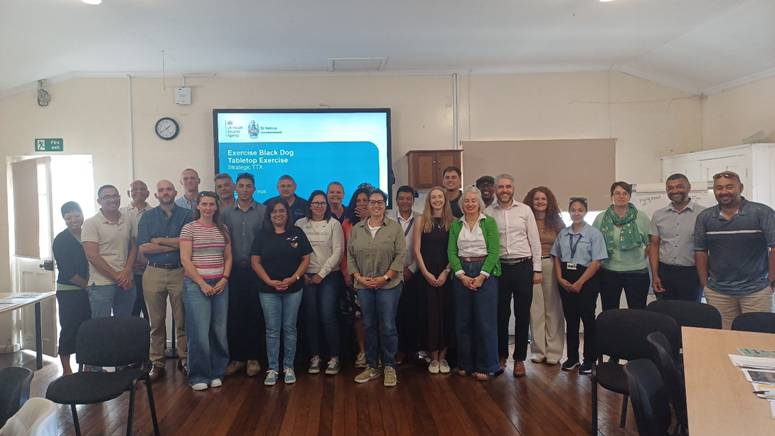
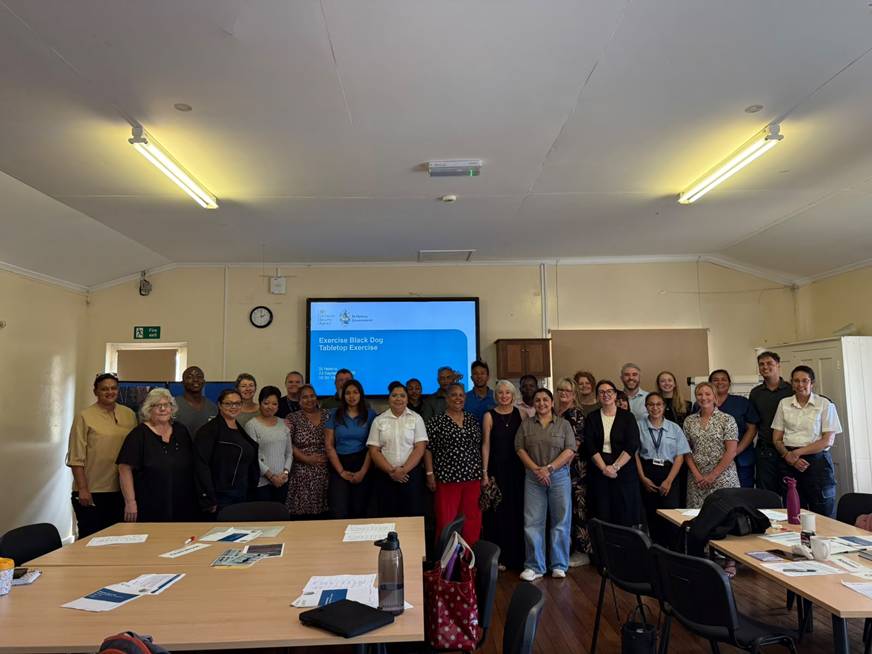
Attendees of Exercise Black Dog
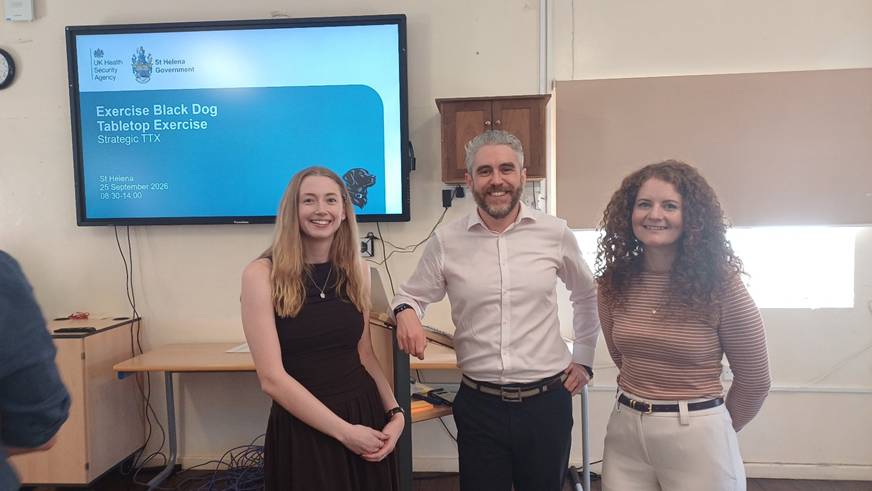
Trainers of Exercise Black Dog
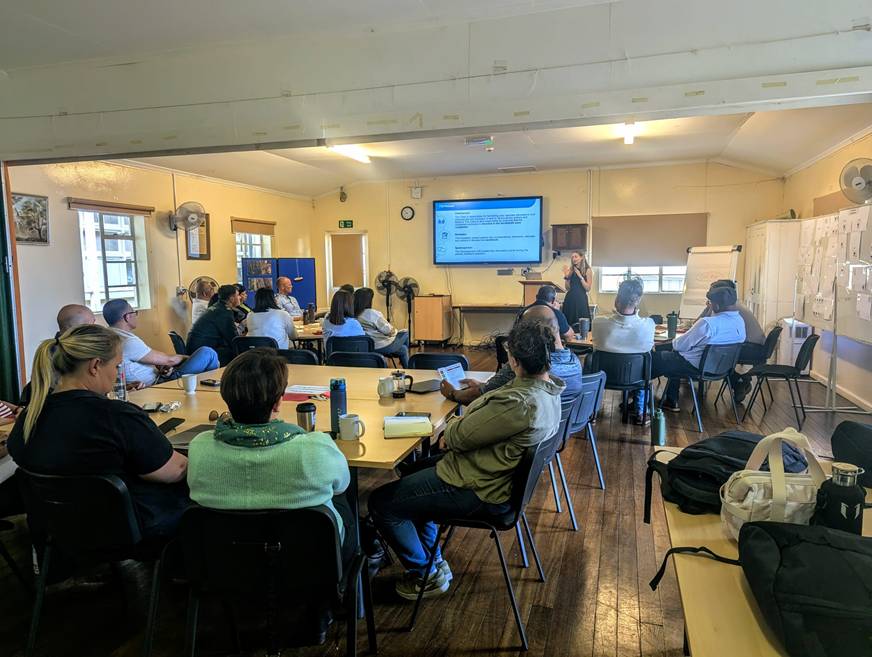
Exercise Black Dog
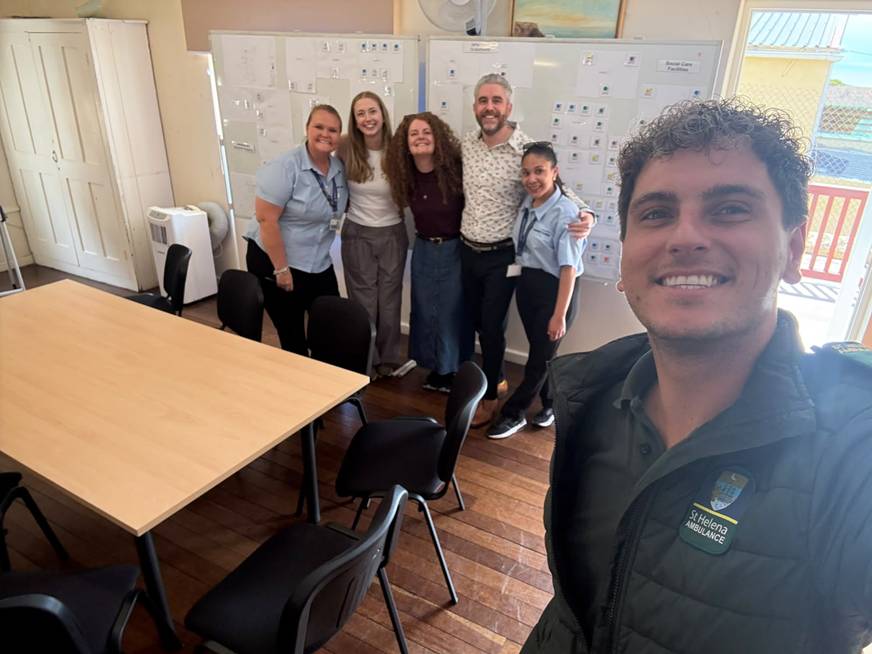
Emergency Planning and Trainers
#StHelena #EmergencyPreparedness #MassCasualtyPlanning