
Latest Posts
The Social & Community Development Committee (SCDC) monthly meeting took place on Wednesday, 10 March 2021.
The Acting Chief of Police presented Quarter 3 (October – December 2020) Police Performance Report and an update on Risks. The report rated performance measures against strategic objectives and overall was deemed satisfactory. No issues of major concern were identified.
An overview of a supplemental note to last year’s initial review of the Elections Ordinance was provided to the Committee. This supplemental note included considerations on international observance of elections, whether those with Saint Status should be allowed to vote and whether the Register of Electors should, or could, remain open for new additions or corrections immediately after a writ of election is issued. The detail of these additional considerations will take place at a special SCDC meeting later this month.
An updated draft Archives Lending Policy to strengthen its provisions is still awaited. The draft Policy was previously discussed in Committee and by Executive Council.
Work is ongoing to progress the Immigration Policy with the aim that the draft Policy and proposed legislation will be ready for consideration in the next three months. A summary report of the Public Consultation held on the draft Immigration Policy in November and December 2020 can be found on the SHG Website via: https://www.sainthelena.gov.sh/documents/summary-public-consultation-report-draft-immigration-policy/.
Updates from the Children and Adults Social Care Directorate (now known as the Social Care Directorate under the Health and Social Care Portfolio) included:
- The Directorate continues to run at capacity in terms of residential and supported accommodation across the Island with the exception of the Princess Royal Community Care Centre (CCC), where there are three vacant placements.
- Due to the high dependency needs of service users admitted to the CCC in recent weeks, it is not anticipated filling the vacant placements in quick succession. Since meeting with the SCDC, all three vacant placements have been filled, but on a phased basis.
- To provide a safe and quality service, there are ongoing challenges to raise standards and practice across our services including through better equipment and resources such as pressure relieving mattresses, mobility aids, adaptions, seating, staffing levels and upskilling staff through training and development.
- Work is underway to install a new call system at Cape Villa which will improve all-round safety.
The Better Living Allowance (BLA) Policy has been updated and recipients will now be reviewed under the revised Policy. Each case will be reviewed taking into account a number of factors and in accordance with assessed/changing needs. Each recipient of BLA will receive a letter about the review.
The allocation of Welfare Assistance has also been reviewed, therefore all recipients of Welfare Assistance will now be informed that a) the directorate maintains ownership of items purchased, and b) the directorate has the right to reclaim the goods. The criteria for reclaiming goods is clearly set out in a letter which will be issued to recipients in due course.
#StHelena #SCDC #MeetingSummary
https://www.facebook.com/StHelenaGovt /
https://twitter.com/StHelenaGovt
SHG
7 April 2021
The ocean wildlife and diverse ecosystems of St Helena and other UK Overseas Territories (UKOTs) will soon be more visible than ever thanks to pioneering work to establish a major network of underwater camera deployments known as the Global Ocean Wildlife Analysis Network.
Funded as part of the UK Government Blue Belt Programme, St Helena Government’s Marine Section will work with scientists from the Centre for Environment, Fisheries and Aquaculture Science (Cefas), the University of Western Australia and Blue Abacus, in a world first to supply and analyse the data collected from 66 non-intrusive stereo-Baited Remote Underwater Video Systems (BRUVS), which will be deployed in open ocean and coastal habitats.
Consisting of two small action cameras embedded within a base bar, a bait arm and a vertical upright, BRUVS record all animals that appear in the cameras’ overlapping field of view. The first BRUVS were deployed in the early 2000s to document the fish communities in shallow coastal waters, expanding in 2014 to open ocean monitoring. Since then Professor Meeuwig’s University of Western Australia team has completed over 70 surveys in 35 international locations, obtaining records for more than 140,000 animals.
The BRUV camera systems will allow St Helena and other UK’s Overseas Territories to see below the surface and provide a benchmark of scientific understanding of the marine species within their maritime area, allowing the more informed decisions about protecting and managing the marine ecosystems. Other UKOTs involved in the project are Anguilla, Ascension Island, British Antarctic Territory, British Indian Ocean Territory, British Virgin Islands, Cayman Islands, Montserrat, Pitcairn, and Tristan da Cunha.
This initiative builds on progress to date through the Blue Belt Programme to improve our understanding of the marine environment of the UKOTs, and to ensure these diverse ecosystems are protected and managed for future generations. Through the programme, the UKOTs have put in place large-scale marine protection and management measures which cover an area of over four million square kilometres.
#StHelena #BlueBeltProgramme #BRUVS
SHG
6 April 2021
The public is advised that Elected Members will hold a round of constituency meetings during April.
These meetings are an opportunity for you to meet with your Councillors and raise any issues you might have.
Constituency meetings will take place at 7pm as follows:
| Venue | Date |
| Kingshurst Community Centre | Monday, 19 April |
| Half Tree Hollow Community Centre | Monday, 19 April |
| Jamestown Community Centre | Tuesday, 20 April |
| Harford Community Centre | Wednesday, 21 April |
| Guinea Grass Community Centre | Wednesday, 21 April |
| Blue Hill Community Centre | Monday, 26 April |
| St Mary’s Church, The Briars | Monday, 26 April |
| St Michael’s Church, Rupert’s | Tuesday, 27 April |
| Silver Hill Bar, Levelwood | Wednesday, 28 April |
| Sandy Bay Community Centre | Thursday, 29 April |
You are encouraged to attend a meeting in your district.
SHG
6 April 2021
The Health Directorate has published revised health service fees and charges, effective from Thursday, 1 April 2021.
The revised fees and charges for residents and non-residents can be found on the Health Directorate page of the SHG website via: https://www.sainthelena.gov.sh/directorates/health/.
SHG
6 April 2021
A passenger currently in quarantine at Bradley’s Camp has taken ill. The passenger’s condition is not COVID-19 related.
The passenger having tested negative for COVID-19 pre-departure, on arrival to St Helena and on Day 10 of quarantine, poses minimal risk to the community and healthcare workers.
Unfortunately the passenger’s condition is serious and requires urgent surgical intervention. The passenger’s condition cannot be effectively treated or fully managed at Bradley’s Hospital facility, and is therefore being transferred to the General Hospital for treatment where they will remain in isolation.
All COVID-19 operating procedures are being adhered to, these include isolation, PPE, physical distancing and testing. It is not anticipated that additional measures are needed, such as quarantining of the nursing and medical teams who are managing this ill patient.
SHG
03 April 2021
The fishing vessel Ramses Dous remains in St Helena waters under quarantine conditions, following the identification of positive cases of COVID-19 on board.
The vessel has delayed its onward journey in order to have ease of access to medical assistance, should this be required.
The quarantine period is due for review on Tuesday, 6 April. The vessel will come alongside Rupert’s Jetty, for the purpose of swabbing. The swabbing process will be carried out by the crew who have been instructed on the process at the previous boarding of medical staff.
The swabbing will be overseen by the Doctor and Charge Nurse from Bradley’s Hospital, these staff will not have any contact with any other SHG personnel during this operation. Whilst onboard the vessel, they will maintain the appropriate social distance and provide direction and oversight only, this is to ensure that the swabbing is carried out correctly by crew members.
The use of the medical staff who have been involved with the Ramses Dous from the point of its arrival, reduces the number of personnel involved in the operation and significantly minimizes the risk.
The Doctor and Charge Nurse will be in a bubble arrangement whereby they will drive from Bradley’s Hospital to Rupert’s Wharf and return. They will use a dedicated vehicle which will then enter quarantine with them. This follows the procedures used for drive-through testing which members of the public will be familiar with.
A further update will follow in due course.
SHG
3 April 2021
Executive Council have repealed Regulations restricting entry to St Helena with effect from today, Thursday 1 April 2021.
This means that individuals can enter St Helena by land and sea, subject to normal Immigration Laws and requirements of the Public Health Coronavirus Regulations.
It is therefore likely that members of the community will see new people arriving to St Helena over the next few weeks, including individuals arriving by yachts.
SHG
1 April 2021
The public is advised that Elected Members will hold a round of constituency meetings during April 2021.
These meetings will be an opportunity for you to meet with your Councillors and raise any issues that you may have.
Confirmed meeting dates and venues will be published in due course.
SHG
1 April 2021
SHG has been made aware of concerns from the public that the vessel Ramses Dous is adrift North of James Bay and could potentially be fishing whilst in St Helena waters.
The vessel is unable to anchor in James Bay as it is not in possession of a mechanism needed to deploy the anchor that is on-board. The Captain communicated this to SHG authorities at the time of their SOLAS request.
Port Control has therefore instructed the Captain to remain between two to three nautical miles outside of James Bay. This distance is in order to maintain quarantine conditions on-board as well as to avoid the vessel from drifting ashore.
It is not possible for the vessel to use any of the vacant mooring buoys in James Bay in order to moor closer to shore, as the moorings aren’t certified to accommodate the weight specification of the fishing vessel. To use the moorings would pose a health and safety risk to other marine occupants in James Bay.
Since last week, the vessel has remained just outside of James Bay in quarantine conditions and has been monitored since their arrival by the Marine Enforcement Section to ensure no fishing takes place.
The Marine Enforcement Section monitors St Helena’s 200nm exclusive economic zone (EEZ) and also monitors a 100nm buffer zone around the EEZ.
Port Control, and the Marine Enforcement Section, are confident that the Ramses Dous is adhering to local maritime and fishing regulations whilst in St Helena waters.
SHG
31 March 2021
In conservation, we’ve learnt that it is only through continuous learning, continuity of effort, and timely intervention that builds on the experiences and knowledge gained by people over time, that progress can be made and sustained.
The work to save and restore the fragile cloud forest habitat on the Peaks is a good example of this. Work has been ongoing since 1995, after it was highlighted that the cabbage trees and tree ferns were disappearing. Back in 1995, the concern was the uncontrolled spread of flax. Today, the threat from invasive species is much greater, with over 23 species of invasive plants requiring control. In this time, other invasive non-native species threats have also increased including rats, mice, rabbits, myna birds, European wasps, mites, mealy bugs, and Scobius and Fuller’s rose weevils.
Conservation on the Peaks has had to adapt to the changing threats and conditions. Lessons learnt, from successes and failures, help us to build more robust approaches resulting in our weed control and ecological restoration techniques being continually refined and developed.
Invasive species threaten the future of the cloud forest and the security of our water resources – around 40% of our water comes from the Peaks. Unless we find a way to upscale the restoration work there is a real chance that we will lose the battle and more endemic species will become extinct. The current Darwin Plus (DPLUS099) funded project has provided funding to employ six extra staff to reduce the imminent threat of loss of the last remaining wild dogwood, whitewood and black cabbage trees and the plants and animals that depend on them.
Over 115 individual sites, or fragments, were identified under the earlier Darwin funded (DPLUS029) “Securing St Helena’s rare cloud forest trees and associated invertebrates” project which contained one or more ancient cabbage trees. These fragments are critical to the restoration of the Peaks because they contain an essential pool of the genetic diversity of the species, necessary to maximise the genetic diversity of future plantings, giving them the best chance of having some resilience and ability to adapt to change. As ancient remnants, these wild cabbage trees also support a rich biodiversity of associated endemic plant and animal species, acting as reservoirs, from which these unique species can expand out from, populating new areas as new suitable habitat is created.
Under the current programme, work is being conducted across prioritised areas to control weeds, reinforce with plantings of endemics grown in the nursery, and to connect some of the fragments through ‘corridors’ through which species can ‘move’ – physically in the case of an invertebrate, or via pollen or seed movement for plants.
The Peaks teams however need to know much more than the various protocols for controlling weeds in order to work safely and effectively in their jobs and to sustain the benefits of their efforts. To grow and retain skills, training and application of new knowledge is needed and this is just what has been happening over the last few months at the Environmental Management Division (EMD):
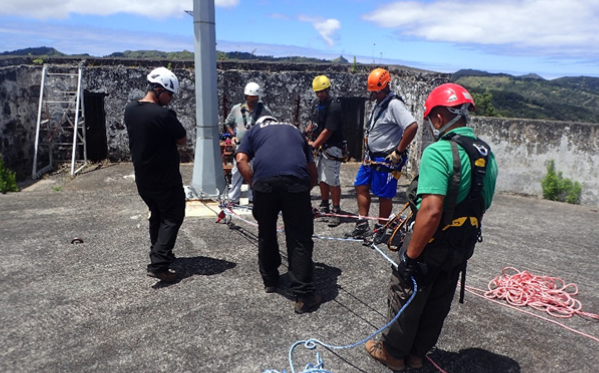
Safe working practise with ropes – many of the sites that both the DPLUS project team and the core EMD Peaks and Species Teams work on are steep, unstable slopes, and cliff sites. Six staff from the Peaks Team and two from the Species Team have been undertaking training with St Helena’s Fire and Rescue Service Brigade Manager, Alan Thomas, supported by Watch Manager, Jason Lawrence, and Firefighter, Daniel Yon.
Safe use of pesticides – while chemicals are not used generally to control invasive plants or pests on the Peaks, there are some cases when they are needed (e.g. in the nursery to control pest infestations or to apply directly to the cut stump of a quinine tree). In the nursery we prefer to use organic treatments for control, but even these need to be used safely. The training was delivered by James Fantom and covered the theory of environmental vegetation management, herbicide selection and calculations, herbicide safety, and knapsack spraying.
GPS training – the cloud forest habitat might not be very big (16ha) in area, but it is very difficult to navigate because of the steeply incised ridges, deep gulleys and valleys, and the density, height, and rate of re-growth of vegetation. Therefore, finding suitable working sites and recording where species is found is an important skill to have. This course was delivered by GIS Manager, Devlin Yon, and covered how to setup a handheld GPS, how to pick up waypoints and define them, and plotting new points.
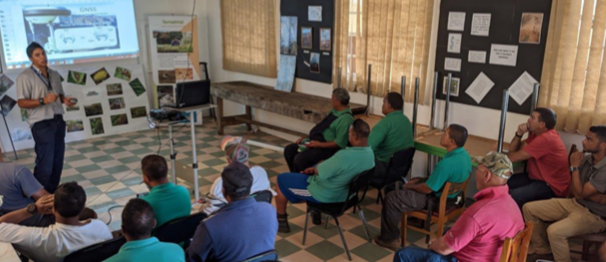
Team working – we recognise just how important team work and good working relations are to achieving positive progress and maintaining the health and wellbeing of the teams, particularly given the remote, and sometimes challenging, working environment. A presentation on inclusion and diversity was delivered by Senior Human Resource Officer (Learning and Development), Jackie Moyce, and Human Resources Business Partner, Bronwen Yon.
NVQ Level 2 Diploma in Environmental Conservation – this is a work-based qualification and two members of staff have registered as candidates with City and Guilds.
Staff also attended a training session on how to use the control method on the wasp and the big-headed ant – this was run by the National Trust Invertebrate Team.
This formal training is also being supplemented with on-the-job training covering a range of activities and protocols including seed collecting protocol and nursery scheduling and production, both of which are important to ensure that the conservation work protects the genetic integrity and diversity of all species. Further training is planned in the coming months in the use of drones for surveying and monitoring, invertebrate ecology, and surveying and plant surveying.
A huge thank you to all the trainers and well done to all staff for your commitment to your professional development for work and congratulations on your achievements.
The DPLUS project is being managed by Nursery Officer, Vanessa Thomas-Williams, supported by Coordinator of the St Helena Research Institute, Rebecca Cairns-Wicks.
#StHelena #EMD #SHRI #DPLUS #EnvironmentalConservationTraining
SHG
31 March 2021